Early Hilsenbeck History
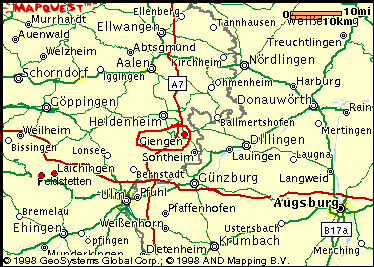
Giengen, a town on the Brenz River some 20 miles NNE of Ulm in Southern Germany, is where our story begins. The church records there begin in 1635. Earlier records were destroyed most likely in 1634 during the height of the 30 Year's War. The Battle of Noerdlingen in the fall of 1634 occurred not far NE of Giengen. The Imperial Army (catholics) won that battle against the protestants and many communities in the region were plundered and burned and precious vital records contained in the church books were destroyed. In Laichingen - later of which we will hear much - the record keeping of the church was not resumed until 1657. We can be thankful to the Evangelical Lutheran Church in Giengen that the keeping of birth, marriage and death records were resumed the year after 1634.
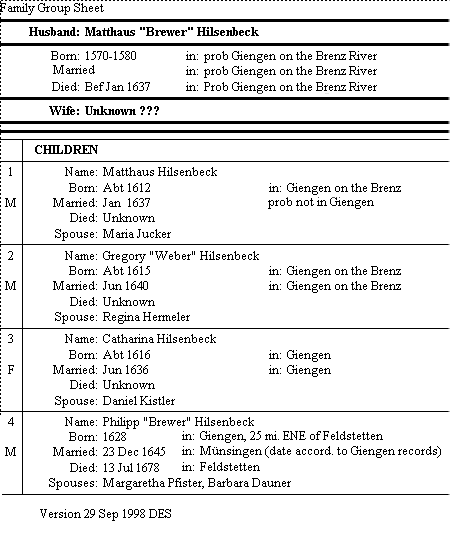
From those microfilmed records, we learn of several children fathered by Matthaus Hilsenbeck - spelled then Hülsenbeck. These were all born before 1635, but their marriage entries during the years 1637 through 1645 suggest their approximate birth years. These children were: Matthaus, Gregory, Catharina and our Philipp. Click here to view the family record. We also learn from these tattered, smudged, ink-faded early records in Giengen that Matthaus was a brewer and that he died sometime before January, 1637 when his son Matthaus married. A search for Matthaus' wife, that is, our Hilsenbeck matriarch, led to inconclusive results. A Waldburga Hilsenbeck's name was found in the death records of April 10, 1636. It stated she was born in 1576 in a different community, that she married in Giengen in 1597. Husband's name was not shown - or not readable. If she had been the wife of our Matthaus, she, by custom, would have been shown as a widow - which was not indicated.
Another death entry is interesting and revealing. On March 7, 1667 a Catharina Hilsenbeck, born Kirchner, died at the age of 88. She had married a Gregory Hilsenbeck in 1613. He died during the Battle of Noerdlingen in 1634 and she remained a widow until her death. In a marriage record of September 26, 1641, Gregory, the late father of the groom Benedict Hilsenbeck, was shown to have been a brewer. This strongly suggests kinship to our Matthaus. Perhaps they were brothers or close cousins.
There were few people in Giengen with this family name in the early years of the records. And searchs for this name in the late 1600s and early 1700s yielded no Hilsenbeck names. So it seems that this family name died out in Giengen, but most certainly not in the surrounding region. For what it is worth, there are no Hilsenbeck names in the Giengen telephone book today.
There were no children found after the 1637 marriage of our Philipp's brother Matthaus. This suggests that he and his bride moved away from Giengen. The other brother Gregory, who married a Regina Hermeler in 1640, did have baby girls who were born in 1642 and 1651. But this may not be a complete record of their children, for the microfilmed church records are in many places terribly faded as to be unreadable. And now let's go to Feldstetten.
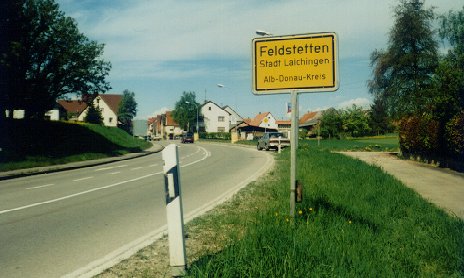
Feldstetten is a community of about 1000 souls (in 1994) and located 2½ miles west of Laichigen and about 25 miles WSW of Giengen. When Philipp and his bride Margaretha moved here in 1646 or 1647, this village lay in ruin as a result of the war between catholics and protestants. According to some sources, the population in early 1634 was between 525 and 800. Between 1635 and 1650, Feldstetten was nearly deserted. Those who had not died at the hands of the Imperial troops, died as a result of starvation or the plague or had fled to the protection of the walled cities and had not returned. In 1654, the population stood at 132. Not until 1743 did the population grow to that of prior to 1634. And so Philipp and his bride came here as did so many others from as far away as Switzerland and Tyrolia to fill up a vacuum. Property was apparently free for the taking. The same thing was occurring in next-door Laichingen.
According to the marriage register in Feldstetten, Philipp married Margaretha Pfister in November of 1646 in nearby Münsingen where her father was the local pastor. You can see that marriage entry by clicking here. However, this date is in conflict with a marriage entry dated December 1645 in the Giengen church records. I am inclined to believe that the Giengen record reflects the correct date of marriage. For one thing, Feldstetten had no local pastor from 1636 until 1653. Clergymen from Laichingen and surrounding communities filled this role until a permanent pastor was found. I think someone errored with the date of November, 1646. Secondly, the first child of this couple, Dorothea, was born on April 8 1647. And while it certainly was not unheard of that a bride was already several months pregnant as she stood before the altar, I don't think this was the case with Margaretha. Pastors during the 17th century often entered very personal comments into the church records such as "This child was born six months too early." No such comment was entered in the birth record of this first-born.
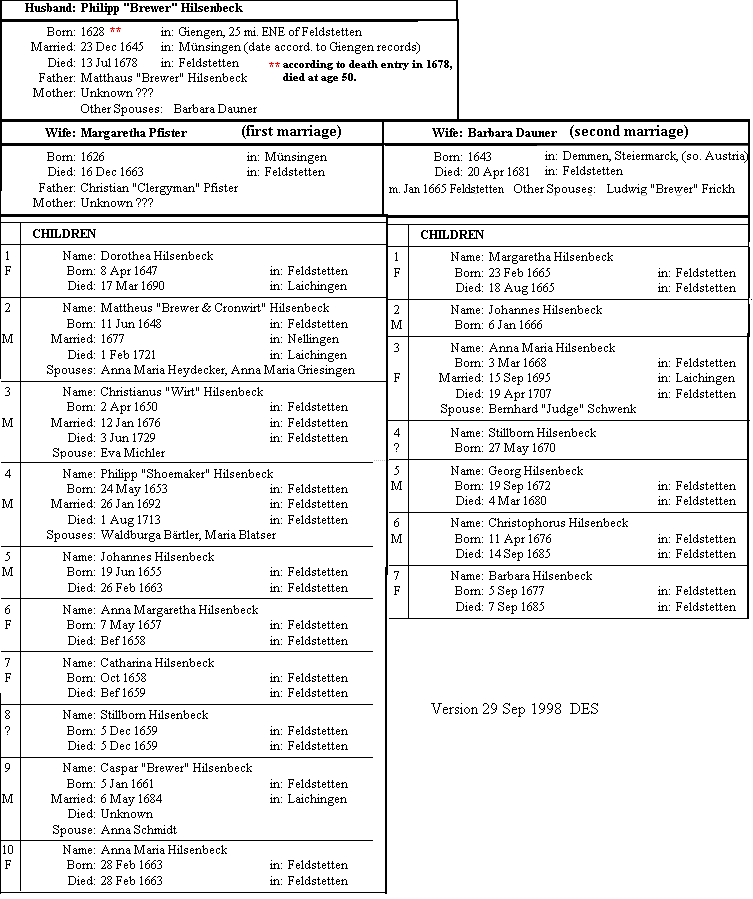
Philipp and Margaretha brought 10 babies into this world. Only Dorothea and four sons, Mattheus, Christianus, Philipp and Caspar survived. Philipp became a shoemaker; the others followed their father's occupation of brewing and innkeeping. Most if not all the Hilsenbecks in America (not yet proven) are descended from Mattheus, born 1648 and Philipp, born 1653. Mattheus and Caspar moved to Laichingen and set up breweries there. Mattheus is shown in one or more birth entries as being an attorney.
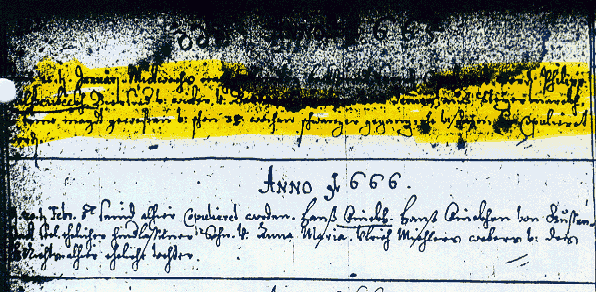
Margaretha died on December 16 1663 in Feldstetten at the age of 37. Either before this time or shortly afterward, Philipp had hired a maid, a Barbara Dauner, who had come from Steiermarck, an area of present-day upper Austria. As the record will show, Philip the widower, got her in the family way and finally made it to the altar in Feldstetten only a couple weeks before the child arrived. You can view that marriage record dated Jan. 25, 1665. In it, the pastor recorded his observations that the bride was 35 weeks pregnant at the time of the wedding. One can't help wondering why our Philipp put off this marriage for so long. There was by custom or law at this time a six month mourning period during which the surviving spouse did not remarry. But simple math will not explain the delay in "getting to the church on time."
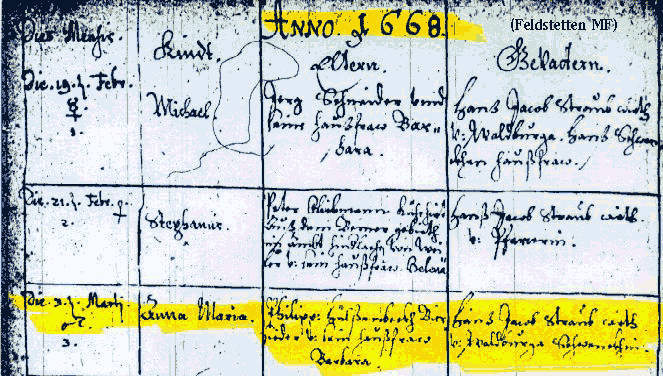
Philipp and Barbara had seven babies. Only one survived, an Anna Maria born 1668. She and her 1695 marriage to Bernhard Schwenk is my connection to the Hilsenbecks. To see a family record of both marriages of Philipp, click here.
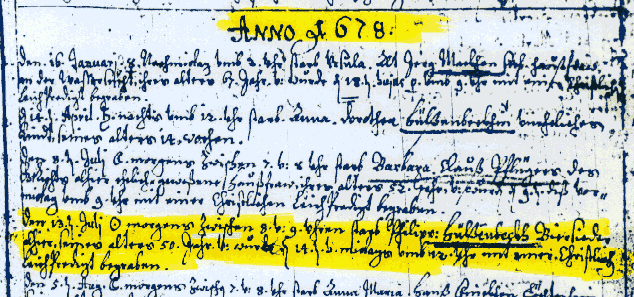
Our Philipp died in Feldstetten on July 13 1678. In the death entry, the age of 50 at death is very clearly written, however I tend to doubt the accuracy of this very much. If true, Philipp would only have been 17 when he married Margaretha. This young an age for a male to marry was practically unheard of. I have run across only two cases in this part of Germany where the groom was as young as 18. And a special dispensation had to be obtained before the marriage could take place. In addition, the birth year of 1628 does not seem very likely when looking at the estimated birth years of his three siblings in Giengen. And then there is a Johannes Hilsenbeck, born 1922 in Laichigen and still living there, who recently informed me that Philipp - our common ancestor - was born in 1618 in Giengen. And so we are left with yet another descrepancy which doubtfully will ever be cleared up.
Brewers and Innkeepers
Under construction.
Moving to Surrounding Communities
Under construction.
Emigration to America
Under construction.
Back to previous
page
Home
This page launched on October 3
1998