Cunrad Schwenck, Master Weaver, Member of the Village Court, Mayor
Conrad was born on June 20, 1702, 101 years after the birth year of his great-grandfather Conrad. Life had not changed much during the passage of the 17th Century. Life was still harsh. The chance of living beyond one's fifth year was about fifty percent. Feudalism was still as strong as ever and would not end until around the mid-1800s. The one who tilled the soil did not - with rare exception - own the land; that was owned by either the Church or the Nobility. The peasant farmer paid the landowner specified amount in cash and crop yearly; he paid one-tenth of his gross yield of crops to the Church, no matter who the owner of the land might be. And so little Conrad entered a world which had not changed much from that which his great-grandfather experienced as a boy.
Before we get to Conrad's life, let us put the year 1702 into perspective. The American Colonies would not declare their independence from England for another seventy-four years; Farenheit's thermometer would not hit the store shelves until 1724; Petersburg was founded the year following Conrad's birth; the first railroad line would not be layed in nearby Bavaria for nearly another 140 years; the automobile, electricity, telephone, radio, and running water in one's home would not show up until about 20 years after those. And Feldstetten, then under the rule of the Duke of Württemberg, and after 1806 the King of Württemberg, would not become part of the modern nation of Germany until 1871. This, then, was the world which greeted our little Conrad.
As we learned above, Conrad's mother died in April of 1707. He and Johannes and his half-brothers Georg, Johann Heinrich, Hans Bernhard and Andreas, and half-sisters Angelica and Anna Barbara were raised by his step-mother, Anna. She must have been a wonderful mother to these children. And the boys all learned the weaving trade from their father as he had from his father, although Johann Heinrich went into farming and this occupation continues today with his descendant, Hans Schwenk b.1930 in Feldstetten. Nothing in the church books is revealed about Conrad's life until April, 1731. He was then nearly 29, and his brother Johannes age 26. They and their betrothed decided to say their wedding vows in the same ceremony there in the church in Feldstetten. Here are the translated entries in the Ehebuch.
On the 17th were lawfully wedded, Conrad Schwenck, journeyman
weaver and lawful son of Bernhard Schwenck, judge and weaver, and
Ursula, the widow of the late F. Jerg Reüber, former linenweaver..
On
the following line, without date entered:
Johannes Schwenck also journeyman weaver and son of the above mentioned
Schwenck, and Anna, the widow of the late Fritz Reüber, laborer and
traveling thresher, the brother of the above mentioned Jerg.
Rather interesting. Ursula and Anna, widows of two brothers again marry two brothers! And Ursula would be Conrad's loving wife for the next forty years, while poor Anna would become a widow once again - within a short time. On the 26th of December in 1732, Johannes died at the age of 27 with some type of illness and high fever. The pastor recorded this event with a warm and caring entry into the Totenbuch. On April 14 in the following year, a son was born to his widow Anna. She named him Johannes. She married for the third time on May 10, 1734. Johannes grew up in Feldstetten and married there in October 15, 1754 to an Anna Margarethe Mack. She must have died sometime before August of 1762, for Johannes then married again, this time to an Ursula Straub. In these two marriages, he fathered 15 children, of which about three girls survived and married. He too was a weaver and became a local village judge like his grandfather Bernhard. He died there 28 June, 1807. Now, back to his Uncle Conrad.
Conrad and Ursula had no children together. This must have been sad for both, for having children in those days was more expected and - if one may say this - even more important. It is quite apparent that Ursula could not have children. In the search for children born to this couple, from the years 1731 through about 1760, Conrad appeared in the pages as Godfather nineteen times between 1739-1755; not one time as father! His occupation was shown as weaver. In 1751 and 1753, "master weaver" followed his name. Conrad must have had much prestige in this community. The parents of the newborn very often requested two important members of the community to serve as Godparents. The man was often an innkeeper, schoolmaster, mayor, judge. The Godmother was often the wife of the pastor, or wife of one of the above mentioned prominent men of the community. Very often the same man and woman would serve as Godparents for the later born children of that couple. Angelika Bischoff-Luithlen said in her book that these Godparents might often begin to "cringe" a bit if the babies started "coming too frequently." Whether Conrad and Ursula ever took in an orphaned child because of this Godfather vow, the church books could not reveal; as far as could be determined, this kind of legal matter was not part of the duties of the church, but rather the courts. In any case it is probable that Conrad and Ursula lived without children in their home. A search in the years preceeding their 1731 wedding revealed that she and first husband Jerg Reüber had brought two or three babies into the world, but all died in infancy. There were two couples living there with the very same names at that time. This writer believes he found the "correct" Jerg and Ursula. Ursula's name was not seen again in the church book pages until in the year of 1771. Here is the entry: "Ursula, wife of Cunrad Schwenck, mayor and local member of the court, died of a heart ailment and was buried in Christian fashion on Jan. 28th."
To the right of this entry the date of 26 January, and her age of 71 years, 10 months was written. Just above this death entry, the pastor entered information regarding the members of the community who had died during the past year of 1770. The total numbered 27. He broke out this number into groups: Married: men, 2; women, 6; widowers, 0; widows, 4 single daughter, 1; children: 8 boys, 6 girls. This is included for whatever it is worth. Conrad was now close to age 69. His wife of forty years had just died. He had no children, no grandchildren. He presumbably was alone for the first time in his life.Whether he was lonely we can only guess. He had lots of nephews and nieces running around the village of Feldstetten - probably lots of grand nephews and nieces as well. And he was Godfather to many young people of the village. Though he must have missed his Ursula very much, his sadness may not have been any greater than his longing for fatherhood. And because we - his descendants - are here reading this story, it is clear that his longings were fulfilled! And so later in that same year of 1771, the pastor penned the following words in that all-important Ehebuch in Feldstetten: Cunrad Schwenck, local member of the court and weaver, widower, and with him Anna Ursula Ostertag, lawful unmarried daughter of Andreas Ostertag, farmer and town council member in Laichingen. Married, 29 October.
Two weeks before the wedding, the local pastor counseled both Conrad and Anna Ursula to satisfy himself that she understood fully what she "was getting into" with the intended marriage to a man of such advanced years (she was age 22½). He entered what he had discussed with this pair into the church marriage records and required the parents of the bride-to-be and Anna Ursula and Conrad to place their signatures at the bottom of that one page entry. Here is a copy of the foot of the document. On the left are the signatures of the parents; on the right, those of the couple soon to wed. Incidentally, the pastor mentioned in the document that Conrad had no children.
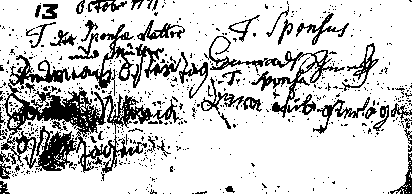
Both her parents' families - the Ostertags and Mangolds - were prominent members of the community of Laichingen. Her grandfather Ulrich Ostertag, then deceased, had been a member of the local court there. We can only speculate as to why she married our Conrad, a man so very much older than her. But we know that even in small villages there were differing social classes, and one usually married within one's class. And too, a marriage to Conrad undoubtedly offered her "financial security". On the other hand, in spite of his age Conrad must have been a charming man, in good health, and highly respected. The fact remains, they married and she moved to his home in Feldstetten. Eighteen months later the following inscription was entered into the Taufbuch and this time within hand-drawn columns. See below a copy of the actual birth register entry.
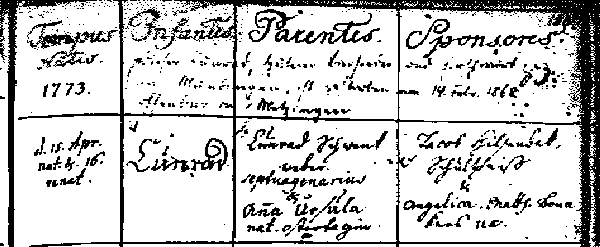
We can all safely speculate that this day must have been one of the happiest in the life of Conrad Schwenk, weaver in Feldstetten. Here he was approaching age 72. His young wife had just borne his first child. One can easily imagine the joy in that house and undoubtedly in the entire village! Note the pastor's insertion of the word "Septugenarian!" Someone, probably a pastor many years later, entered an interesting and special inscription in pencil directly above this birth entry, but you will have to read further to learn of its contents. Three years following the birth of baby Conrad, a baby girl joined the family; Anna Maria was born on May 5, 1775. She died four years later.
Let us take another glance at this man, now close to the age of 73 years. He and wife Ursula learned they could not have children, but he loved her very much and presumbably remained faithful to her during the forty years of their marriage. He became a weaver like his father, and apparently also learned the skills of administrating justice in the local village court from his father Bernhard. Then in 1771 Ursula died. He remarried the same year, and in less than four years he was blessed twice with fatherhood. But all lives like stories must come to an end. And so once again the local pastor pulls out the Totenbuch from its special place of safekeeping, and in the year of 1775 makes the following entry:
- On the 6th of July around 12 o'clock noon, Cunrad Schwenk,
local weaver, also village councilor died of a fever illness,
and was buried in a Christian fashion on the 8th.
The life of Jacob Hilsenbeck, our little Conrad's stepfather, was not very long. He died on March 1781 at the age of only 31. Hitzige Krankheit or "acute malady" was the listed cause of death. That fall on September 25, Anna Ursula married again, this time to a Jacob Hezler, a brewer from Machtolsheim, a village just 5 miles due east of there. His father was also an innkeeper there. This Jacob had never married before. He was four years younger than Anna Ursula, then 32. Jacob took over the Löwen Inn and brewery (presumed brewery, since he and the late Jacob Hilsenbeck were both brewers by trade).
Their first child was born on Dec. 14, 1783. This boy, Christian, survived and married in Feldstetten in June, 1813 to the daughter of innkeeper from another community. Two daughters were born in the following three years. These died in infancy. And then on July 20, 1789, the spirit of our Anna Ursula departed as she was giving birth to her tenth child, stillborn. Only three of these ten survived. Jacob Hezler remarried on June 3, 1790 to a widow, Anna Margretha born Mack. They had four children together, two of which lived beyond childhood. Jacob had a long life. He was born in April, 1753. Died in January, 1842 in Feldstetten.
Before we move on to the next generation, two intriguing tales beg to be put onto paper. They are of the common kinship between Anna Ursula and Conrad and his kinship with the first man who married his widow. Now we must travel back to the year 1601, the year the stork delivered our patriarch Conrad Schwenk. You already know the generations to the Conrad under discussion, but to refresh your memory: Conrad >Andreas >Bernhard >Conrad 1702. Now here is Anna Ursula's connection to Conrad "the Great": Conrad Schwenk 1601 >Andreas >Georg >Anna Ursula >Anna Maria Mangold >Anna Ursula Ostertag b. 1749, marries Conrad Schwenk 1771. Conrad was the great-grandson of Conrad the Great; his wife was the ggg-granddaughter of the same!!! One wonders if they were aware of their common ancestry? Second cousins, twice removed.
And now to Jacob Hilsenbeck who married widow Anna Ursula. You learned of his ancestry in the preceding chapter. His gg-grandfather was Philipp Hilsenbeck, brewer, b. 1628. And that same man was a grandfather of Conrad. And so as it turned out, the widow of Conrad married his first cousin, twice removed. And so the seeds of Conrad of Laichingen and Philipp of Feldstetten would once again join and germinate with the births of children born of this union of their descendants. And so we have come to the end of the fourth generation. Let us now see what life would hold for this little Conrad.
When his father died, little Conrad was just a toddler.When Conrad was age six, his sister Anna Maria died. Two years earlier, on January 5, 1777, a baby boy Johann Jacob was born to his mother and stepfather, but died within the year. On January 8, 1778, a Dorothea was born and survived. During the following two years, two more babies joined the household but did not survive infancy. Conrad was not yet eight when his stepfather died in 1781. As we know already, his mother then married Jacob Hezler. This second stepfather would be the man from whom Conrad would learn the skills of brewing beer and innkeeping. His half-brother, named Christian, was born on Dec. 23, 1783. He and Dorothea would be Conrad's childhood playmates, his half-siblings, there in the Jacob Hezler household. Because no artifacts survive except for those entered and preserved in the Kirchenbücher, we are left once again with conjecture, however, it is clear that Conrad learned the skills of brewing beer and innkeeping from this stepfather. And then at age 24 it must have been these skills, this profession, which led to his decision to leave home and move to Mundingen.
Mundingen. This community, pop. circa 300 in 1997, lies about 15 miles south of Feldstetten, five miles west of the city of Ehingen, and just a few miles north of the Donau (Danube) River. It lies nestled on the southern end of a very small basin at an elevation of 2074 ft. Original forests of beech, oak, birch, and conifers grow on the high ground surrounding Mundingen and this basin. All the tillable ground, as in all areas of this region, is under cultivation.
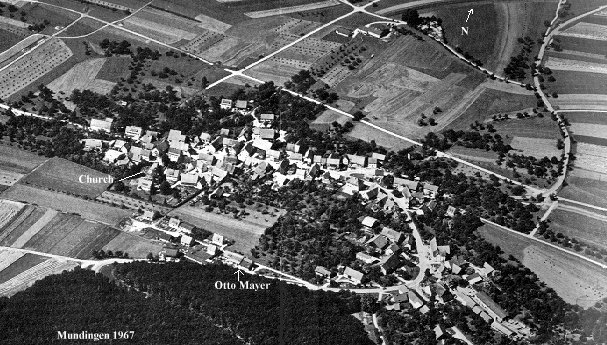
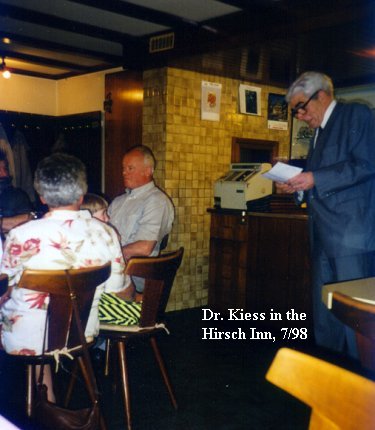
The history of this village is somewhat similar to that of Feldstetten and Laichingen, and reaches back as far. Its first historical mentioning is preserved in a document in the archives in St. Gallen, Swizerland, and was dated in 854 A.D. That document tells us very little about Mundingen except that there existed at that time a small chapel. To go into depth on the history of Mundingen is really outside the scope and intent of this story of our Swabian ancestry. Nevertheless, because Conrad's wife-to-be was a member of a very old and prominent family in Mundingen and whose family name is documented here as far back as 1497, let us take a moment to learn something of the history of the local inn, the Hirsch, of which Conrad soon would become proprietor. But before we do that, it must be acknowledged that the source of virtually all the information on Mundingen is a wonderful, comprehensive, scholarly-written book entitled "Mundingen, Ein Altwürttembergischer Grenzort". It is of the history of this community and was published in 1983 by the city administration of Ehingen. The author is Dr. Rudolf Kiess, an historian, who, with his wife and children, began coming to Mundingen in 1976 as a "retreat" from their home in Stuttgart. As he indicated in the introduction section of his book, written in 1983: As an historian, he could not help from becoming interested in the history of his new surroundings; and this led, over the following seven years of much research, to the writing of this book. The family name Schwenk appears quite often in it. We Schwenks stand in great indebtedness to Mr. Kiess and his wife Pauline (she modestly declined to be named the co-author)!
Brief History of the Hirsch. In the mid 14th Century this village consisted of eleven Höfe (farms or estates). These included the houses, outbuildings, croplands, pastures and woodlands. These eleven properties were then owned by four different monasteries in the surrounding area, and the House of Württemberg. Although Württemberg was a minority landowner in Mundingen, it ruled this small community, which in effect was an enclave surrounded by other sovereignties. No land or buildings were then privately owned by the peasant farmer (with the exception of a few acres of garden-orchard plots and a very small amount of farmland).
One of these original eleven farms was what this book lists as "Haus # 7", which today is the Gasthof Zum Hirsch, the inn. In 1366 this property and accompanying farmland was given to the Cloister of Urspring by a Berthold von Stein. At that time, the "occupants" of the property were a Hans der Weber and App der Mayer. In 1649, one year after the devastating 30 Years War, the Cloister of Urspring sold this property to a Jacob Breymayer, the most prosperous peasant farmer in Mundingen. This was very significant because it was the first farm owned freely by a peasant farmer in this community, and now not by the Church or Nobility.
Jacob Breymayer died in 1668. Sometime between then and 1713, this farm was subdivided. The smaller of these now two properties included the house (# 7). His nephew Georg inherited or purchased this smaller property; the larger property came into the possession of a Johannes Breymayer, first-born son of Georg. Sometime around 1726, Georg's son Friedrich, whose occupation was brewer, converted part of this house to an inn - a place of food, drink and lodging (see photo taken late 1800s/early 1900s). He then built a three-story brewery/distillery directly adjacent to the inn. Friedrich died in 1734. Ownership passed to his widow and then to Jerg Koz, her second husband. Upon his death in 1763 the property passed to Johann Jacob Breymayer, the son of Friedrich. He died in 1767 and his widow then married an Elias Fischer in July, 1768. The property was then deeded over to Elias.
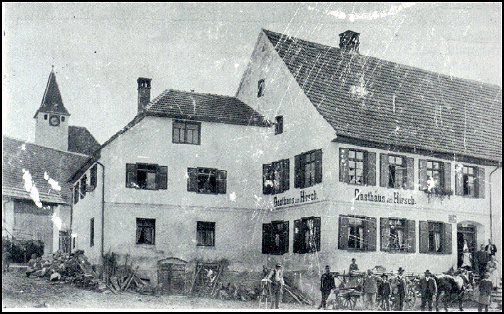
Johann Jacob Breymayer and his wife, Anna Elisabetha, born Blifers, had five children at home when he died. One of these was Felicitas, just three years old. For her, Elias Fischer was the only father she would know. More about Elias later in this Schwenk saga. It was this little girl, Felicitas, who in 1797 was a young, eligible bride (although already age 33) when Conrad Schwenk from Feldstetten came strolling into town.
Whether it was Felicitas or a possible job opportunity which initially drew Conrad to Mundingen, we'll probably never know. Perhaps Elias Fischer, then getting up in years, had put out the word for a reliable young man to run the brewery/distillery? But we can be quite certain that Conrad moved there in 1797. The church books recorded all the souls residing in Mundingen in 1796. The list categorizes married couples, widowed persons, single girls (Felicitas in that list) and boys, and even a column of "non-citizens", people living there at that time, but not permanent residents; Conrad Schwenk's name does not appear in the list. The number of souls was approximately 170.
As far as could be determined, the family name Schwenk had never been entered into any of the Kirchenbücher in Mundingen (which go back to 1641) until May of 1797. This occurred in a wedding on May 16, 1797. The groom was "Conrad Schwenk B. u. Biersieder u. Felicitas Breÿmaier." "B" means Burger or citizen of the community; Biersieder means brewer. Note the spelling of Felicitas' family name; this was written over the centuries in at least eleven different ways, with Breymayer and Breimayer now being the usual spelling.
This newly wedded pair made their home in the residential part of the "Hirsch" Inn, where Felicitas was born and had lived all her life. Her mother and stepfather Elias Fischer continued residing there also, but in makeshift quarters in the basement. With the marriage, the ownership of this property passed over to Conrad with the payment of 2500 Gulden. Fifteen Gulden then might buy a cow, thirty Gulden a horse. The property included the house/inn, storage shed/grainary, farm equipment, brewery and 8-9 acres of farmland.
Not long after the above paragraph was written, a letter containing startling information was received from our wonderful friend in Stuttgart, Dr. Rudolf Kiess. Yours truly then excitedly wrote a letter to his cousin Richard L. Schwenk, a copy of which is reproduced below.
Tuesday Aug. 22, 1995 Bellevue, Idaho
- Dear Cousin Richard, care of sons John and Robert:
What a wonderful family reunion that was! I thoroughly enjoyed every minute! When I arrived home last Wednesday, letters from Heinrich C. Schwenk and Dr. Kiess were waiting. Heinrich and family were about to leave on a one month camping trip, and he apologized for writing his letter so hastily. He asked me to extend his greetings to you and Caring and wondered if son Michael had made connections with you. He also said his daughter with two children are/were in the Phoenix, AR area on vacation. The letter from Dr. Kiess brought with it such interesting information that I wanted to share this with you (and Juanita and Darrel). I replied with a 3 page letter shortly after arriving home. I will enclose copies of my letter rather than write about those subjects again in this letter to you.
- Dr. Kiess went to the Mundingen Town Hall and found the marriage contract,
dated 28 April, 1797, drawn up before the marriage of Conrad Schwenk to
Felicitas Breymayer. He (and probably with help of Pauline) then transcribed
this long hand- written "prenuptial agreement" into modern German and enclosed
a two page single-space typed document. It is still difficult for
me to read because of so many archaic terms, but I will do my best to translate
parts of this agreement, principally the 20 Conditions of this agreement
or contract (that word, Contract, was in fact used in this document). First
let me refresh your memories. Felicitas was then 33 yrs. of age. Her father
had died in 1867 when she was three. Her mother remarried one year later
to Elias Fischer, a brewery worker, who had come from Weilheim, a
town perhaps 20 miles NW of Mundingen. So now thirty years later our Conrad
comes strolling into this out-of-the-way hamlet, apparently having heard
that Elias was looking for a buyer of the "Hirsch" (that is only an assumption
of mine). Felicitas had never been married. Her mother then was age 66,
and step father Elias, the owner of this property (a widow loses her right
to own property upon remarriage) was then probably about the same age (I
could never find his date of birth as hopefully revealed in his death entry;
I checked again today for this in the years between 1797 and 1804; He must
have been buried back in his hometown, but when his wife, our Anna Elizabeth
died in 1803, she was a widow). Anyway, the 20 Conditions have mainly to
do with the concerns of the parents there in their twilight years.
If you will recall, the 3 story Brewery/Distillery building stood directly
adjacent to the main Haus (the Inn) to the east of the present entry door
of the Inn. It was torn down some 20-30 years ago. The brewery building
had been built back in around 1720-1730 by our ancestor Friderick Breymayer,
grandfather of Felicitas, and parts of the house converted to an inn. Now
to the 20 Conditions.
1. All the brewery equipment, vats, pots, casks and tubs are included
in this purchase.
2. Whatever has to be built in the rooms of the brewery will be paid
for by both parties (not clear if this meant the seller and buyer jointly,
or the two buyers, Conrad and Felicitas?).
3. The seller reserves for his life long use the loft above the Brewery
facing the well (village well directly across the street (north) of the
property).
4. Likewise the small room by the Dürre (for drying fruit and
presumably also in the brewery building).
5. The buyer must provide for the seller, at no cost, yearly 2 tankards
of brandy, and one half tankard beer daily.
6. The seller reserves for his use the cellar in the large house, and
will pay the costs of installing a door on the side facing the well. (It
appears that this is where he and wife will reside).
7. The seller reserves use of the upper rear room in the event that
son Philipp should become sick or otherwise run into misfortune, and where
the seller can at that time put a couple clothing trunks (Philipp was youngest
brother of Felicitas, and at that time age 31).
8. The seller must be provided one of the three pig pens in the
event he should keep a pig.
9. The seller reserves two small plots by the well for the planting
of lettuce, etc.
10. Likewise a small place behind the house for firewood storage.
11. The seller is allowed to keep one cow in the barn of the buyer,
but is responsible for the acquistion of feed and the feeding of her.
12. The buyer is required to transport four wagon loads of manure to
the fields of the father-in-law.
13. The seller reserves the right to one-tenth of all the fruit.
14. Likewise, one-third of the plot of the community-owned garden area.
Also
15. A one-third share of the yearly firewood allotment (Each "full-fledged
citizen" of the community, that is one who owned his house, had paid the
one time fee for this privelege of citizenship, could vote
for the election of the mayor, schoolteacher, town council members, etc.,
likewise had the right to go into the community-owned forest land to chop
a specified amount of firewood each year)
16. The seller retains the front upper part of the barn (part of the
house structure) for the storage of crop harvest.
17. The Käuferin (female buyer, that is in this case, Felicitas)
receives, in addition to a 6 times the minimum dowry amount, two cows,
one as part of the purchase and the other as part of the dowry.
18. Two tables along with three guest tables, three chairs and two
Schrannen (boxes to sit on) in the main room, and also the sofa behind
the oven are left for the Käuferin (Felicitas).
19. The father-in-law approves the common use of whatever household
utensils/kitchenware there is (this suggests that both families would
share the kitchen). And finally,
20. If either the father-in-law or the son-in-law should die, the widow
is not allowed to remarry.
Along with the above mentioned building and equipment, the purchase included crop and pasture land. Perhaps 12-14 different very small parcels. The measurements shown are abbreviated symbols which I don't begin to understand. If I recall from Dr. Kiess' book, this property included something like 8-10 acres of land. Would Conrad have farmed this land himself? I don't know. PROBABLY he had his hands full with the brewery and inn and may well have sublet this land. Farm equipment was, however, included in this transaction. And did Elias still own other land? I don't know, but the Condition # 12 suggests that he did. Anyway, I hope you have enjoyed hearing this interesting story. It was a pleasure for me to share it with you.
With affection, Don Schwenk
cc: Darrel and Juanita Schwenk
1797 Possessions Inventory
of Conrad Schwenk & Felicitas Breymayer
Date:
Mon, 25 Aug 1997 09:28:24
-0600
From:
Don Schwenk <uncledon@micron.net>
In old Wuerttemberg until the middle of the 19th Century, the state required that an inventory be made of all the possessions of the newly married couple. Chattel and real estate. This was called das Beibringen. All their joint assets which were brought to the marriage. The grand total served as the basis of later taxation by the state of the gain (capital gains we would call it today) upon the death of either of the spouses. Directly after a death, another inventory was conducted, and once again all possessions were itemized and current market value assigned to each item - down to the last thimble. A Richter - we would call him an assessor - would travel from the administrative city to the village where the inventory would be made. He would require the assistance of the local village Schultheiss - local all-powerful mayor/sheriff - and the village bailiff to conduct the inventory.
Conrad Schwenk, b. 1773 in Feldstetten, had come to Mundingen, some
10 miles south of his home village, in January, 1797 and had been accepted
as a citizen there. By citizen is meant that the village council had accepted
him into citizenship upon their approval and his payment of a rather substantial
fee. This entitled him to vote in the local elections of council
members, the
school teacher, etc. And it entitled him to a specified number of cords
of firewood each year from the village-owned forest land. Conrad had learned
the brewing and innkeeping trade from his step-father Jacob Kezler. So
at age 23, he apparently heard that Elias Fischer, who getting up in years,
desired to sell the Hirsch Inn and brewery in Mundingen. And he had an
eligible
step-daughter Felicitas Breymayer, then age 33, who desired marriage.
So in April of that year, a marriage contract was drawn up. It contained
20 conditions. You can read those in our SchwenkNet Website in the
history section. And then on May 16th, they married. The newlyweds
occupied the res. part of the inn and her mother and step-father Elias
moved to upstairs - attic part of the building, with the kitchen being
shared by both families.
And now back to the 20th Century. On August 14th 1997, I received a
30 page document from Dr. Kiess of Stuttgart. He is currently doing
more research on the history of Mundingen. He had found this 1797 inventory
in the town hall and then photocopied all these pages for me. He
and his wife then penciled in either English or modern German translations
of many of the archaic terms. Without those translations, I would have
remained ignorant of many of the objects of the inventory; A modern
dictionary offers little help in these matters. I will not attempt to list
all items - chattel and real estate - brought to the marriage by our Conrad
and Felicitas. I will show only those which seem most interesting.
But first you must become
somewhat familiar with the currency values of the time. Otherwise two
Guldens and five Kreuzer will be meaningless. A Gulden at that time was
what we call a dollar (ca. 1871, currency changed in Germany to the Deutsch
Mark). A Gulden was worth 60 Kreuzer. A third denomination was the
Heller. The smallest coin of value. Like a penny of today.
Conrad bought the Inn, brewery and its equipment, garden area and some
10 acres of farmland for 2500 Gulden. Felicitas' 4 yr. old cow, owned
prior to marriage, was assessed a value of 30 Gulden; her 8 yr. old cow
20 Gulden. The assessor from the administrative city of Münsingen,
who lodged in the Hirsch Inn for two nights during the inventory was charged
13 Kreuzer for
"lodging and drinks." The charge for "oats and hay" for the horse he
had rented to travel to and from Mundingen was 40 Kreuzer for two days.
The fee charged for his renting the horse for two days was one Gulden.
I hope with these examples you will have gained a feeling for what a Gulden
was worth.
The inventory was made on 21 Nov. 1797. I do not understand why
this was not done directly after the wedding in May. The inventory
form used was a standard one used in this part of old Wuerttemberg. First
section was for chattel - personal possessions. The second for real
estate.
Under chattel, here are the categories: Cash, Jewelry, Books,
Clothing, Beds, Linen Bedding, Brass Containers, Pewter, Copperware, Iron
Utensils, Tin Utensils, Wooden Utensils, Furniture, Miscellaneous, Livestock,
Crops, Grain/Hay/etc. in storage, Food, Tack (saddles, etc.).
Conrad's Assets:
Cash: 2800 Gulden. What is interesting here is that it was stated
this money he had received as inheritance from his late father and mother
and monies from his living step-parents in Feldstetten. He had
paid 2000 of this as down payment in April for the property.
Jewelry: 0
Books: A hymn book, a bible, a sunday school book and one old
hymn book. Market value: ca. 2 1/2 Gulden.
Men's clothing: 2 hats, one green felt cap, one pair of good shoes,
one pair of boots, and a leather pants. Total value: 10 G.
That's about it for Conrad except for a couple cupboards and boxes.
No livestock nor tack. His total assets in personal property and real estate:
2902 G, 27 Kreuzer. Then to be deducted from this figure were:
12 Gulden for Burgershaft (citizenship acquisition fee) costs.
15 Gulden for the wedding costs (one half paid by him, the other by
the bride). Net assets of Conrad: 2875 G., 27 K.
Felicitas' Assets:
Cash: From dowry/inheritance from her late father and late grandfather:
478 Gulden. And 39 Gulden of her own savings.
Books: a bible, hymn book and sunday school book.
Silver Jewelry: one pair of shoe buckles worth 2 G. Pendant of
pearls worth 6 G.
Clothing: Large number of skirts, all described briefly by color.
Pots and pans and furniture, nothing worth much. But she did own a
Gehimmeltes
Bett, a four-poster - you know - the kind with a top and probably with
closeable curtains around the sides.Worth 6 Gulden.
Livestock: Two cows, worth 50 Gulden totally.
Her total assets after the 15 Gulden deduction for the wedding costs:
692 Gulden.
Sum of assets for the couple: 3568 Gulden, 3 Kreuzer, 1 Heller.
Then at the end of the 30 pages of inventory, the assessor lists his expenses for conducting the inventory. I have mentioned some of those up above (horse rental charges, lodging, etc.). The total costs of conducting this inventory was just short of 7 Gulden.
One of the most interesting parts of this large document was to find the signatures toward the end of this of Conrad, Felicitas,and then of her mother and step-father Elias Fischer. Thus we now have signatures of these four, and earlier in 1771 of Conrad's parents and her parents upon the marriage in Feldstetten. Plus that of our clergyman ancestor Samuel Christoph Lieb in 1690!
Also of interest was the notation written in upper left corner of page one which indicated that this document had been re-examined upon the death of Elias Fischer in Jan. 1803. I had never been able to find his death date before in Mundingen (though it was not stated as to where he died). Felicitas' mother died then that same year in Mundingen.
Though these ancestors of ours did not own much fancy personal property,
they were actually quite well off. Very few people of the day could afford
to buy a property like the inn, brewery and land. 3868 Gulden assets
at the beginning of the marriage was a lot of money in those days.
It would be interesting to see the inventory made in 1842 after the death
of Felicitas. Dr. Kiess said in his letter that he would be finding some
more "tidbits" for us there in Mundingen. Maybe that will be one
of those. Alles Gute. Don Schwenk
The next child born was Elisabetha. She died shortly after her birthdate of Sept. 8, 1800. A boy christened Conrad was born exactly 13 months later. He too died in infancy. The next child was born on the 8th of November, 1802. She was also named Elisabetha, but she survived those many maladies which afflicted and robbed so many infants and young children of their adulthood in those days. At age 26 there in Mundingen, on March 2, 1829, she married a Johann Friderich Ampfer, a gamekeeper from Hohen Wittlingen, a community not far from Mundingen - about five miles SE of Dettingen/Erms. She moved to his village, for no Family Register was established for this couple in the Mundingen Lutheran Church. She did have a child born out of wedlock two years earlier, a Johann Friderich, born May 23, 1827, who ten months later died. The father was that same Johann Friderich Ampfer whom she later married in 1829. And that is all we know of Elisabetha except that she served as Godmother in Dettingen for her brother Johannes' first two children. A death date could not be found in the Mundingen records, but she was presumbably living in Metzingen just west of Dettingen/Erms when her father died there in 1867. A search was made by this writer in 1998 in the microfilmed church records of Hohen Wittlingen which revealed that four babies were born to this couple between 1827 and 1833. He was still a gameskeeper for the state. An unreadable notation then indicated to what community they moved in ca. 1833.
Conrad was the sixth and last child born. He arrived on June 16, 1805. Across the Atlantic, Lewis and Clark and party were struggling up the headwaters of the Missouri. And Brigham Young, to whom the research of our past owes so much, was only four years old. You can read much more about this Conrad's life in the Riches to Rags page in this Web site. And you can view his family record here.

Conrad's name was spelled this way upon his birth, but on his Family Register, Conrad was spelled with a "K", as was it usually in Dr. Kiess' book. We will spell it as Konrad, mainly out of the hope of avoiding any further confusion on the part of the reader!? Konrad had a long and interesting life. He was the only one of the siblings who stayed in his home village; he married, raised a family of five (all of whom lived to marry and have children), and died there; and because he did not wander, we know more about him than our own Johannes, his older brother. He married on Aug. 28, 1832. He learned from his father how to run an inn and brew beer. In 1832, the year of his marriage, his father turned the business over to Konrad. In 1844 he sold the inn - the Hirsch - but continued operating the brewery/brandy business in the adjacent building. This was a three story building (torn down some twenty to thirty years ago) and it is probable that he and his family resided in the upper portion.
In 1862, when Konrad was nearly sixty, he built a new house in the upper, southeastern part of the village which still stands today and is occupied by Konrad's descendant Frieda Beck Rehm (see below). In 1868, the brewery and land passed on to his son Elias (born 1839). Elias had married in January, 1869 and his wife bore a son posthumously who was named after his father. In 1901, Elias Jr. married his 2nd Cousin Katarina Schwenk in Mundingen, the daughter of Friedrich, son of our Johannes. They had no surviving children, and he died in 1908. Elias Sr. died in 1869 following injuries sustained while working on the Danube Valley Railroad. And so after 220 years of remaining in the hands of the Breymayers' and the Schwenks', this property passed on to an non-related family. And one can still today lodge, dine and party there at the Hirsch. But don't expect that possibly a Schwenk might wait on you, for there is no longer anyone in Mundingen carrying this family name. The closest one is Erwin Schwenk, a farmer in nearby Hayingen, a 4th cousin of the author.
At about this time Konrad took on the job of local constable and nightwatchman. From the evidence at hand, it seems that had fallen on hard times. The job paid very little and probably didn't give him much to do, because the population of Mundingen stood at only about 250, though his sleep must have been interrupted from time to time - aside from having to make his nightly rounds. In Dr. Kiess' book, in a section entitled, "The Church Convent Watchs over the Morals", the following excerpt, taken from the Church Convent Books, appears:
- In 1873 the daughter-in-law of the constable was warned because
she had had, particularly during Advent, several young single men
at her place for a beer party.
This "sinner" almost certainly was Elisabeth Schwenk, the young
widow of Elias, the late son of Konrad Schwenk, the local "constable".
This writer is tempted to relate more about this Elisabeth and Elias and
their son Elias born after the early death of the father Elias, but that
would take us too far afield. However there are people living today in
Mundingen who descended from two of Konrad's five children and are thus
blood related to us, and this then deserves space in this story.
Only one of the five children born to Konrad and Maria Eva married and raised their children in Mundingen. Maria Brigitta Barbara, born Jan. 9, 1846 - the last-born - married a Jacob Mayer in 1871. He founded a cabinetmaking business which his great-grandson Otto Mayer still operates today. He is the fourth cousin of this writer, with Conrad - the first Schwenk in Mundingen - representing their common ggg-grandfather. And we have relatives living in Ohio today who descended from this same Maria B.B. Schwenk. Her sister, Crescentia Felicitas married a Johannes Rilling in Pfullingen in 1877 and later emmigrated to the USA. During a return visit in 1893, apparently to visit her sister Maria in Mundingen, Maria consented to allow Crescentia to take three of Maria and Jacob's children back to America. Presumably these children, ranging in age from 17 to 21, were raised by Crescentia and her husband. A daughter of one of those children recently (1995?) celebrated her 100th birthday in Worthington, Ohio. Her name is Toni Blackford.
One of those five children of Konrad and Maria Eva was Johann Jacob. He married in 1866 in a village not far from Mundingen. He farmed for a living. One of his daughters, Eva, married an Johann Georg Beck in Mundingen in 1890. One of her grandchildren is Frieda Rehm, born Beck. She lives today still in Mundingen in the same house that her gg-grandfather Konrad Schwenk built in ca. 1865. And so here is another descendant of our Conrad Schwenk, brewer and innkeeper, still in Mundingen. And there are other cousins living nearby which we will talk about shortly.
It is interesting to trace these kinship ripple effects. In this case one could say the origin of this kinship rippling was the marriage of Conrad and Felicitas in 1798, but then again one could say the same for the marriage one generation earlier between Conrad and Anna Ursula.
There is one more "connection" to our cousin Otto Mayer which deserves mentioning, and here it is. During the author's brief visit in Mundingen in May of 1994, a photo was taken of the only "Schwenk tombstone" in the church graveyard. This was of a Johannes Schwenk, b. 1910, d. 1984. Whose son was he? Was he our Conrad Schwenk's descendant? And if so, through which line? These were nagging questions which remained unanswered until recently, and then almost purely by chance. There were no names of Schwenk babies entered into the Mundingen birth registers during the 20th Century until the year 1947. And these were twin girls Barbara and Gertrud, whose father was the Johannes Schwenk mentioned above. The family register of this Johannes was discovered purely from "wandering" through the Mundingen microfilms. Here is what it revealed, going backward in time: Johannes >Anton >J. Jacob >Konrad >Conrad Schwenk. But here is the connection to Otto Mayer and his 85 year old mother: The wife of this Johannes Schwenk is Pauline Haydt, the sister of Babette Mayer, Otto's mother! And there surely are other relatives living today in Mundingen, the descendants of that young ambitious brewer who strolled into this village in 1797; It would only require more time and patience to search out these living descendants from the "dusty old pages" of these microfilms. And those twin girls born in 1947, the ggg-granddaughters of our Conrad, brewer? They are still living in the Mundingen area and are married to local farmers. Dr. Rudolf Kiess ran across them during a Heimatfest in the summer of 1995. They told him they knew nothing of their father's ancestry. A chart was then sent by this writer so that they might learn of their Schwenk roots. And so now, thanks to historian Dr. Kiess, we have found two more cousins. This writer visited them in June, 1996 at Gertrud's farm in Kochstetten, a hamlet a few miles NW of Mundingen. And then there is a Straub family living in Mundingen. He descended from Maria B.B. Schwenk, daughter of Konrad. And so if any of you someday visit Mundingen, you will find several relatives there, all descendants, like us, of Conrad Schwenk, brewer/Hirschwirt.
We have gone a bit astray here with the story of the life of Konrad, our Johannes' younger brother. To bring a conclusion to it: Maria Eva, Konrad's wife of 47 years, died there in Mundingen in 1879. Konrad passed away two years later at the age of 76.
Before we turn our attention to our Johannes, we need to return to the parents, Conrad and Felicitas. Conrad, like his father, must have possessed considerable prestige in the community. But that was part and parcel of being a Wirt, an innkeeper. It was here where the village council held its meetings, at least in small communities where no Rathaus, town hall, had yet been constructed. The inn was the meeting place; wedding parties took place here; the town council held their "post meetings" here if they had, in fact, a Rathaus in the community. It was the Wirt who greeted the dignitaries and took care of their horses, their lodging and other needs. And it was the Wirt who was usually one of few in the village who always had cash on hand.
And so this Conrad, like his father, was requested often to serve as Godfather at christenings. He did this repeatedly during the years 1808-1815. He was designated as "Hirschwirth" each time; and during the years, 1810-1815, also as village council member.
The local Mundingen records show, as stated in Dr. Kiess' book, that a Schwenk built a new home in the first half of the 1800s just a stone's throw west of the Hirsch. This must have been our Conrad, because he had turned over the land, business and buildings to son Konrad in 1832. This home still stands and its address is "Haus # 9."
We can only assume that Conrad, then about age 60, had gone into retirement.
There is nothing in the church books which reveal what he and Felicitas
did in those retirement years. On Sept. 26, 1842, at the age of 78, Felicitas
died of old age, according to her death entry. She had been the wife of
Conrad for 47 years. And now he was alone for the first time in his life,
although he then had four grandchildren there in Mundingen and six grandchildren
a couple hours' walk south in Neuburg on the Donau (Danube) River. We do
not know if he remarried. We know from an entry made on his Family Register
in Mundingen that he moved to Metzingen (just west of Dettingen/Erms) in
around May of 1866. And now back to the birth entry made in the Feldstetten
church books back in 1773. Just above that entry, written in pencil, is
the following statement:
- This Cunrad, later beerbrewer and innkeeper of the Hirsch in Mundingen,
died on 14 Feb. 1868, reportedly in Metzingen.