Little baby Johannes drew his first breath of air on July 5, 1798. He was the first-born of Conrad and Felicitas Schwenk. What kind of world greeted him? Well, there was a lot of talk going around then about a certain Napoleon Bonaparte, a young 29 year old general not far away in France. When Johannes was age two, Napoleon's armies began warring with the Austrians. The Danube River valley lay only a few miles due south of Mundingen and had served as a corridor for armies through the centuries. And thus, some of those French troops, as well as Austrian, found their way to this little out-of-the way village seeking the requistion of horses and cattle and bread, as well as lodging. In 1797, just before Conrad took over the Hirsch Inn, his future father-in- law Elias Fischer was paid nearly 40 Gulden to provide lodging and food for some French officers. And because this conflict between the French and the Austrians went on through 1805 culminating in a battle in nearby Ulm on Oct. 16, in which the French Army was victorious, it is very likely that Johannes' Father also must have waited on French and Austrian soldiers passing through this village. At about this time, the Duchy of Württemberg became an ally of the French, and Napoleon elevated the Duke to the rank of King. And so Johannes grew up a subject in the Kingdom of Württemberg.
Johannes' life was somewhat similar to that of his father's; he learned the skills of the brewer and innkeeper from his father (in Conrad's case, from his step-father) and left his home village to start a business of his own, although Johannes would wander a bit, as we will see.
In the year 1828 in Dettingen (on the Erms River), a town located about
32 kilometers northwest of Mundingen, there lived a Johann Friderich Lieb
and his wife Maria Agnes. He was a prominent member of that community;
he was a member of the town council and had served as mayor in 1819. His
occupation and main income derived from the ownership of an inn, also named
The Hirsch. Hirsch is the German word for the antlered stag, and
this was a symbol, a trademark, of the House of Württemberg. Therefore,
nearly every community in old Württemberg had an inn carrying
the name of Hirsch. Whether Herr Lieb had put out the word that his
inn was for sale, or that he needed someone to operate it, we do not know.
The only event we can document is that Johannes went
to Dettingen sometime around 1828. He, like his father, fell in love
with the daughter of a Hirschwirt and in that year in Mundingen and
Dettingen, Johannes and Maria Barbara Lieb proclaimed their intentions
to marry. This is documented in the marriage entry of the Mundingen church
books and the Family Register later established in Dettingen. The wedding
took place in Dettingen on Nov. 16, 1828. The Mundingen document shows
Johannes as "Hirschwirth zu Dettingen." The Dettingen Family Register,
prepared probably sometime in 1834, shows his occupation as "Sattler,
auch (also) Hirschwirth". And this same dual occupation appears in
the birth registers in 1830 when their first child was born. It seems thus
very likely that Johannes learned the skills of making
saddles and harness before he arrived in Dettingen.
Johann Friderich Lieb had died in June, five months before the marriage of daughter Maria Barbara to Johannes. He left a widow with three daughters and a son (these younger siblings of Maria, then age 20) to take care of. The widow, Maria Agnes, did not remarry until 1840, so it seems likely that Johannes became, more or less, the head of the household there above the Hirsch Inn in Dettingen (which no longer exists). On March 6, 1830, baby Maria Agnes Felicitas was born.
On April 8, 1831 grieving filled the home with the still-born delivery of a male infant. On July 21, 1832, their first-born son arrived; they named him Elias. As mentioned earlier, Johannes' sister, Elisabeth, came to Dettingen to serve as Godmother at the christenings of babies Maria Agnes and Elias. Then on May 8, 1834, Johann Friedrich joined his brother and sister. A sketch of the lives of these children, as well as those of the subsequent siblings, will follow near the end of this chapter.
Sometime between May of 1834 and December of 1835, Johannes, Maria and their three babies moved to very small community called Rosenau, at that time consisting of only one house and this owned by the neighboring village of Hagelloch. This is on the northern edge of the city of Tübingen, 25 kilometers due west of Dettingen. It is very likely that Maria's mother and juvenile siblings moved there with them. The reasons for this move we will probably never know. Had business at the Hirsch Inn turned sour? What was it which drew them to this hamlet? The only fact we know for certain is that Maria's mother married a Jacob Müller there in Rosenau in 1840, about five years after this move. We also know that Maria Barbara's sole surviving brother (out of 15 children born to her parents), Jacob Friderich, married in Entringen, right near Rosenau, in January of 1840. And a younger sister, Christiana, married sometime in this period in Hagelloch, the village directly adjacent to Rosenau.
A baby Johannes was born on Dec. 20, 1835 there in Rosenau. He died - as concluded from scribbled and blurry entries made some five years later in Mundingen - after only two days of life. Then on Christmas Eve, one year later, baby Luise joined the family.
Sometime between then and January of 1839, our Johannes, Maria and children moved to a small village of Kayh, located on today's Highway B 28, about 8 miles NW of Tübingen and Rosenau. Although not yet documented, it is likely that Johannes went there to do farm work. The economic conditions in So. Germany at that time - crop failures, overpopulation, and industrialization in Northern Germany and in England - had led to desperate times. And those conditions lead to waves of emigration; and that is, in part, why we grew up in America and are reading this in the English language.
There in Kayh on the 23rd of January, 1839, baby Johannes was born. On August 3, 1840, in the same village, Carl August made his entrance. Six years then passed before the last child of Johannes and Maria was born. This was baby Elisabeth, born on August 6, 1846 in Mundingen! She died 13 hours later.
Mundingen? The home village of Johannes! Had he moved back there? Did they travel the considerable distance from Kayh just for this delivery? No is the answer on both accounts. They had moved to Neuburg probably shortly after the birth of Carl August in 1840. Luise, born in 1836, would tell her children many years later in America, that she was born in "Neuburg, Oberamt Ehingen." And this was probably because her first memories stemmed from her childhood in Neuburg.
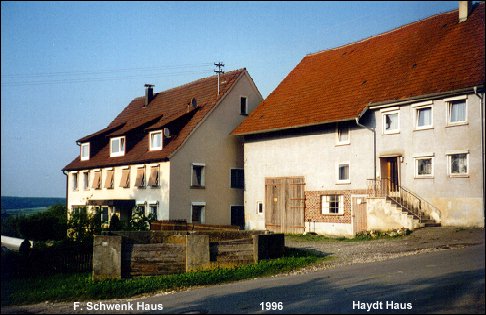
Neuburg is a hamlet (population of 68 in year 1854, according to a letter from Dr. Kiess in June, 1995), which lies on the north bank of the Danube River right near where the Lauter River joins the mighty Danube. Mundingen lies just north over the hill from Neuburg. This little community was then nearly 100 percent Catholic (according to the same Kiess letter, only four of the 68 were protestants in 1854 - those probably were Johannes, Maria and two of their children , age 14 and older). Mundingen, Dettingen and the other communities where the Schwenks had lived were all Lutheran. Whether a person was of the Catholic or Protestant faith, had been determined by which duchy, principality, sovereignity one lived in. In 1534, the Duke of Württemberg elected to join Martin Luther's break from the established Church, and thus all his subjects within his territory or duchy had to henceforth adhere to this new denomination. Had the village of Laichingen been situated a bit farther eastward, and not within the Duchy of Württemberg, we Schwenks today may well have been raised in the Catholic faith.
Neuburg lay in a sovereignty just outside the boundaries of old Württemberg,
and its secular sovereign, Austria, had elected to "stay with
the Pope." And so it is somewhat a puzzle why Johannes, Maria and their
six small children moved there sometime shortly after August, 1840. Why
not back to Mundingen, just over the hill, where his parents and brother
still lived? The reason probably lies in that fact that Mundingen
had a saddle maker then and Neuburg apparently none (Oh why didn't
these people keep diaries and hand them down, cries out the family history
researcher!!). There is no evidence to indicate that Johannes continued
to earn a living as a Wirt, innkeeper. On the contrary, the Family Register
filled out in around 1840 in Mundingen reflect
the only occupation as that of saddler.
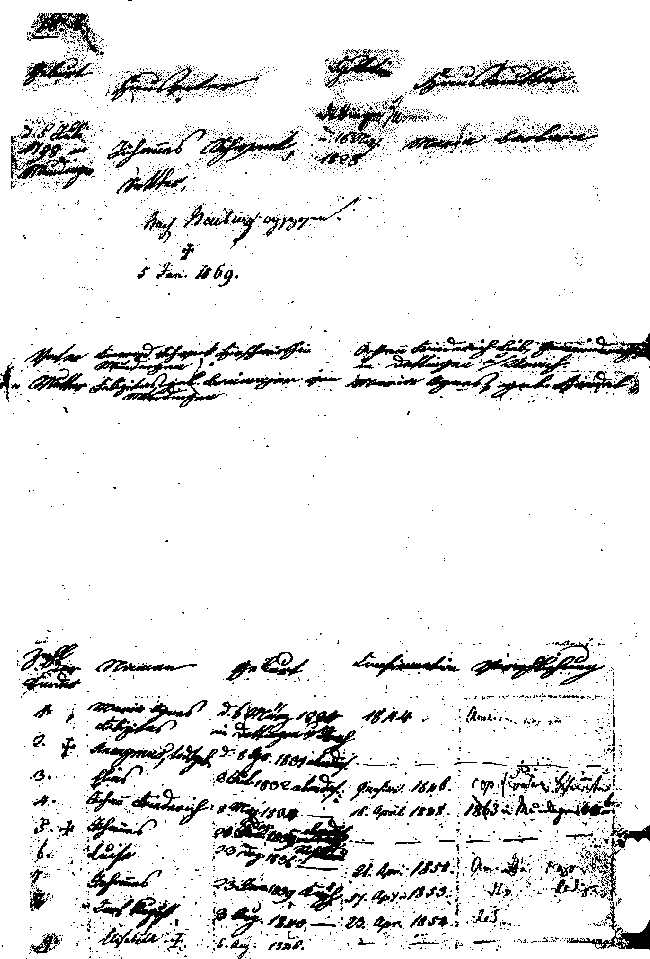
All six of the surviving children were confirmed in the church in Mundingen as each reached the age of fourteen. These events are recorded in the Family Register of Johannes and Maria, a copy of which you can see by clicking here. Apologies for the poor quality due mostly to the poor penmanship of its author.
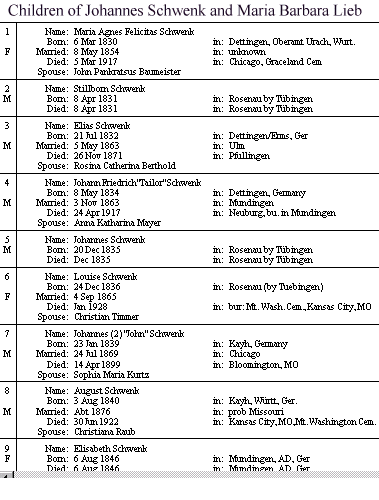
Life Sketches of the Children of Johannes and Maria. Information about the lives of four of these children has been handed down to, gathered and preserved by Juanita Schwenk, wife of Darrel Schwenk in Excello, Missouri. We owe her a great debt. These four children were the ones who left their homeland and emigrated to America: Maria Agnes; Luise; Johannes and August. The other two, Elias and J. Friedrich remained in Germany; information about their lives had to be extracted almost exclusively from the church books, as was the case with all the preceding generations. We will sketch their lives in the order of their birth, leaving Johannes or John, for the seventh generation chapter. Click here for a view of the family record.
Maria Agnes Felicitas was born March 6, 1830 in Dettingen. She married a John Pankratsius Baumeister on May 8, 1854 somewhere in Germany.** A search in the Mundingen church books showed they did not marry there. They arrived in Chicago on July 8th of that year "after a voyage of 35 days." They had thirteen children. One of those was named Elias. She died on March 5, 1917 just seven weeks before the death of her brother Friedrich back in Mundingen, and is buried in Graceland Cemetery in Chicago. That is really all that is known about her by this writer. It seems odd that more is known of the parents and two brothers who remained in Germany than their siblings who settled in America! Apologies are made by the writer to those descendants of Maria Agnes, Luise and August who may someday read this story; more information was simply not available to the author. **In November of 1996, some many months after writing the above, it was learned that John Baumeister was born in the village of Buchay near Riedlingen, some seven miles SW of Neuburg. This is most likely where he and Maria Agnes Schwenk married. The current phone books of Germany show two Baumeister listings there (of a total of 1295).
Elias was born on July 21, 1832, in Dettingen. He became a baker, then married a Rosina Catharena Berthold in Ulm on May 5, 1863. They had five children together, four of which survived. The last born child was Johannes Elias, born in 1870 in a hamlet called Urspring about 20 kilometers west of Ulm. In the following year on Nov. 26, 1871, Elias died in the city of Pfullingen, not far southwest of Dettingen/Erms. As the reader can see, he died young at the age of 39. His cousin, Elias, son of Konrad, also died young at the age of 30. And Elias, born 1869, son of Elias (son of Konrad) died in 1908, without any surviving children, at the age of 39. One could say - if one were superstitious - that the name of Elias, which had stemmed from a beloved Elias Fischer, had a curse attached to it. It seems peculiar that the knowledge of the existence of Elias, born 1832, did not get handed down by his four siblings in America. The "archives" in the home of Juanita and Darrel Schwenk did include the name of Friedrich, their other brother, but nothing about Elias. One could speculate that Elias was the blacksheep of the family who ran off to Ulm and married a woman who at that time had a child, age 5, born out of wedlock. And to bring "more shame", their first child was born about 7 weeks after the wedding ceremony. And then again it could be simply that the information about this brother Elias merely slipped through the cracks of time and thus failed to be preserved in Juanita's "archive".
Johann Friedrich was born on May 8, 1834 in Dettingen. He went by the name of Friedrich. On Nov. 3, 1863, he married Anna Katharina Mayer in Mundingen. He made a living with cloth, having become a tailor. Dr. Kiess sent copies of some original documents housed in the Mundigen town hall in 1997. These indicate that Friedrich had come to Mundingen in about 1863 as a tailor from Dettingen. So it is very probable he moved to Dettingen from Neuberg to learn this trade.He remained a tailor and lived out his life in Mundingen. There were seven children born of this union. The first child arrived about 21 months before the vows of marriage were said. Two of the sons emigrated to Swizerland; two sons died before the age of marriage; only one of the three daughters married or remained there in Mundingen. The one, Katharina, married her second cousin Elias Schwenk in 1901. Their only child was born dead. And so there were no male descendants of Friedrich to carry on the family name in Mundingen or take over the business.
In spite of that, a Gottlob Schwenk was born within this family on Christmas Day in 1896. The mother was Maria Barbara, age 18, unmarried and the youngest daughter in the family. It is fairly probable that Gottlob was raised in the household of Friedrich and Anna. The Family Register shows Maria Barbara as the mother; it also shows her subsequent marriage in 1906 to a Wilhelm Bühner, whose homeland was in northern Germany. It is very likely they then moved out of Mundingen, for they established no family register in this church. Gottlob is shown as being confirmed in Mundingen in 1910. It must have been heartbreaking for Friedrich when, on August 12, 1916, this child died on the battlefields of war in the Somme Province of NW France while serving his nation, this only "son" who had not left Mundingen to put down roots somewhere else, but had gone off to war. Gottlob's name appears along with seventeen others from Mundingen on a war memorial plague in Mundingen, which is depicted on page 63 of the Kiess book. So we see here a picture emerging as to why the Schwenk name did not survive in Mundingen. It was a poor village and times were very difficult there in the middle of the last century; why else would young people pack up their belonging, leave their parents, their hometown, and sometimes even their homeland?
And on that subject, there is an interesting story about Maria Barbara, mother of Gottlob, which begs to be told. In July of 1995, a Frau Straub in Mundingen found a poem in her husband's papers; she gave a copy of this to Dr. Kiess, who then sent it on to this writer. This handwritten, poignant, beautifully rhymed and metered three-page poem was written on Jan. 11, 1904 by Barbara in "St. Ludwig", (Ludwig = Louis, hence, St. Louis, Missouri) and sent to a Maria Gerster who would marry a Theodor Straub the following month in Mundingen. The bride-to-be was Barbara's first cousin. This same Maria Gerster had served as Godmother for baby Gottlob in 1896. Barbara's mother Anna, and Maria's mother Maria Barbara were sisters, two of ten children born to Johann Georg Mayer and Anna Barbara Kauther of Mundingen.
In the poem she mentions the passing of her own mother in November of the prior year, and also of the death of the mother of the poem's recipient, nearly two years earlier. She also rhymes her regrets over not being able to attend the wedding. What is particularly interesting here is that Barbara had gone to America sometime after December, 1896, and returned to Mundingen sometime before her own wedding in 1906. Who did she live with there in St. Louis is our logical question? Since the facts are, at the present, not available, let us speculate. Her Aunt Maria Baumeister was then living, reportedly, in Chicago, Illinois or environs. This older sister of Friedrich - Barbara's father - is most likely the American relative that Barbara lived with for a few years. But then again, she had an Uncle August living in the Kansas City area and an Aunt Sophie and cousins in Bloomington, MO. And was it the shame of bearing a child out of wedlock which precipitated her visit to America? We can only surmise.
This poem appears in the Homespun
Poetry page of this Web site in both English and German.
To the best of this writer's knowledge, it is the sole surviving document
passed down to us from our
Germanic past; that is, something written by a niece of our "four immigrants"
in the German language. The beauty of the rhythm and cadence is missing
in this writer's translation into our language of this touching poetry
. Nevertheless, this writer has decided to include the English translation
of the original poem as well as the German version.
With Friedrich's marriage to Anna Katharina Mayer, we find yet another connection to the Otto Mayer family living there today in Mundingen. Anna was the sister of Jacob Mayer. It was this Jacob who, in 1871, married Maria B.B. Schwenk, cousin of Friedrich. But then again like they say, in small communities most everyone is related to each other.
In the year of 1863, the year of their marriage, Friedrich built a new home (Haus # 33) in the upper, southeastern part of Mundingen, directly across the street from where his Uncle Konrad would build his home (Haus # 37) in the following year. And a few years later, Jacob Mayer would build a home (Haus # 35), just two doors away from that of Friedrich and Anna's; they certainly did not have to go far to visit with kin!
In 1903, after 40 years of marriage to Friedrich, Anna passed away. On the 24th of April, 1917, eight months after the death of Gottlob, Friedrich died of "old age", as stated in the Mundingen death book, just two weeks shy of age 83; only seven weeks earlier, his sister Maria Agnes in Chicago had passed on.
Luise or Louise, as anglicized, was born on Dec. 24, 1836 in Rosenau. According to the "archives" in Excello, Missouri, she "came to America in 1861", then being age 25. Whether she traveled alone, whether her destination was her sister's home in Chicago was not documented. She married a Christian Timmer on Sept. 4, 1865. They brought six children into the world, four of which survived. Louise died in January, 1928, and was buried in the Mt. Washington Cemetery in Kansas City, MO. Her grandsons, a Frank and Charles Schroer, live there today.
August was christened Carl August and born on August 3, 1840 in Kayh. Again here, as with his siblings, we know nothing of his childhood. How often he and his family traveled the bad and steep road to Mundingen to visit the grandparents and attend the Lutheran church there we do not know. Neuburg was catholic as were all the nearby communities. And as mentioned earlier, although all these children were confirmed in the Mundingen church at age fourteen, no record was found of their christening there. And so it appears they were christened in or near the villages of their birth.
John Wesley Schwenk of St. Paul, Minn., the youngest child of Johannes (John the immigrant), is to have said that August and brother John served a 3 year stint in the army of Württemberg. If this is accurate, this would have been during the years of 1864 -1867, for Johannes left his homeland for America in 1867. Dr. Kiess, in his book on page # 221, quotes Mundigen pastor Staudenmayer's speech letter written in August of 1872 at the occasion of the acquisition of a new church organ; this was about one year following the 1870/71 Franco/Prussian war, which the Prussians won and which led to the unification of modern day Germany in 1871. The pastor reports, "A war in which four local community members, namely Christ. Wick, Aug. Schwenk, Heinr. Jerem. Haydt and Joh. Gg. Rupp participated without injury." One must conclude from the above that August was then living in Mundingen. His father had died in 1869; his grandparents were no longer living. His mother may have by then moved to America - it is not documented as to when she moved. Or it could be that August and his mother came to America together. The only famliy he then had was brother Friedrich and Uncle Konrad in Mundingen.
We do know when he arrived in America; this is documented on a U.S. Naturalization form dated April 17, 1917. It shows he arrived in the Port of New York on July 4, 1872. He settled in the northeastern part of Missouri, not far north of Macon and Excello. He married a Christina Raub, a German-born woman. Their marriage date is not known to us, but this must have been in about 1876, for their first child, Emma, was born on Sept. 13, 1877 in Kansas City. They had seven children, five who survived and married. There are August Schwenk descendants living today in the Kansas City area. August died June 30, 1922, and was buried also in the Mt. Washington Cemetery in Kansas City, MO.
In 1869 the life of Johannes Schwenk, b. 1798, father of these six children, came to an end. This is documented in an entry in the death books of Mundingen. The cause of death was listed as "old age". The date of death was on January 5, 1869. Place of death was in Neuburg. Place and date of burial was Mundingen on January 8th. He had lived exactly 70½ years. His widow Maria, and brother Konrad and Anna and some of their children, and son August and the other son Elias from Ulm, probably were in attendance at the funeral.
His widow Maria Barbara, sometime during the following few years, left her homeland forever. According to Juanita Schwenk's records, Maria arrived in Chicago, then later moved to the home of son August in Kirksville, MO. She spent her last days in the home of her son John near Bloomington, MO. She died there in 1878 and her remains were buried in what is now a neglected cemetery just west of the former hamlet of Bloomington.
The Seventh Generation
John Schwenk, Farmer and Lay Preacher
On Dec. 5, 1839 in New Rumley, Ohio, a baby boy christened George Armstrong Custer was born. Meanwhile across the Atlantic in the village of Kayh in the Kingdom of Württemberg, several months earlier on January 23rd, a baby boy was born to Johannes and Maria Schwenk. He was christened Johannes and undoubtedly went by that name until he arrived in America. His grandson Darrel Schwenk, and wife Juanita refer to him as "Grandpa John." We will refer to him as John, not Johannes, in the hope of avoiding confusion with his father. We know very little of his childhood and young manhood years; let us try to imagine what he may have experienced growing up in the little village of Neuburg. Let us begin this scenario in the year 1850. John was then age eleven. Sister Maria Agnes was then twenty. He and his five siblings were living with their parents in a house in Neuburg. Father Johannes had his saddle shop there on the ground floor of the residence. John and August must have been helpers in their father's business. They may have apprenticed in this trade under their father - though we have no evidence of this. Older brother Friedrich, then age 16, may have by then moved to Dettingen/Erms to learn the tailor trade. Whether Elias, then age 18, learned the skills of a baker there in Neuburg, or more likely in Ulm where he married in 1863, we can only surmise.
The small Lauter River joins the mighty Danube there at Neuburg, and it is likely that these children learned to swim in their waters. It is more than likely these children frequently hiked the 5 kilometer road north through Lauterach to Mundingen to visit Grandpa Schwenk, their cousins and Uncle Konrad and Aunt Maria Eva. This road had been improved in around 1844 from a earlier footpath, according to the Kiess book; prior to then, one had to travel the old footpath, or travel a 9 kilometer roundabout way through the village of Kirchen, northeast of Neuburg, to reach Mundingen.
It is natural to wonder whether this family owned a horse and buggy or wagon. One might assume that a horse resided in a stall near the saddle shop of their residence, particularly in view of Johannes' occupation. This was, however, in all likelihood not the case. In those days, owning a horse was a luxury enjoyed by the nobles and others of considerable wealth. The more prosperous farmers owned a few horses; the less prosperous only oxen. Ownership of a horse(s) created a type of social stratification between the farmers in a village; to the "upper class" belonged the "Pferdbauern" The poorer farmers suffered the indignation of being called "Ochenbauern." And the prosperity of a community was measured somewhat by how many horses were owned by its inhabitants. Thus it is most likely that this family got around on foot
We do know when John was confirmed in the church in Mundingen; this appears on the Family Register of his parents as having occurred on April 14, 1853 at age 14. Then at age 25, in 1864, it appears that he was conscripted into the army of the Kingdom of Württemberg; this is based on statements handed down by his youngest son, John Wesley Schwenk. In a nine-page letter dated Jan. 23, 1991, written by Richard L. Schwenk and sent to about six descendants of John Schwenk, is found John Wesley's recollections, and here somewhat paraphrased, that, "Johannes (John I) had served in the army for three years and was about to be conscripted for another three years when he left for America." Whether brother August served with John during those years is not known. There was a brief war in 1866 between Austria and Prussia. The southern German states of Baden, Württemberg and Bavaria sided with the Austrians (and lost). It may be that John served in this brief war.
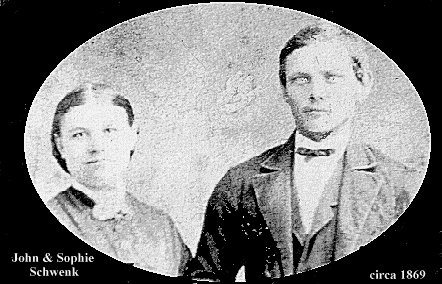
Whether it was concerns over facing another three year stint in the military or wanting to join his two sisters in America, where a much more promising future seemed likely, or a combination of both, we can only guess. It is said John boarded ship and arrived in America in the year 1867. A cursory search in the emigration records have thus far not revealed when and through which port he departed, but we do know that August came through Antwerp, Belgium five years later. It is said that John met a certain Sophia Kurtz aboard his ship. He was then age 28, she age 21. She was born on July 12, 1846 somewhere in Pommern (Pommerania) which is in present day northeastern Germany or northwestern Poland (this geographical fact suggests their ship departed from Hamburg). And that is all we know of her life prior to boarding this ship. John arrived in Chicago and presumably stayed with his sister Maria Agnes Baumeister. As to how this "romance" aboard ship led to their wedding vows being said in Chicago on July 4, 1869, we are left only to speculate.
Richard L. Schwenk's letter of 1991 tells us something of the lives of John and Sophia in America. The following appears beginning on page 3 of that letter and is based in good part on the keen memory of their youngest son, John Wesley Schwenk:
"...Juanita has a photo showing the couple at their wedding. John read in a Chicago paper about the sale of "M and M Bonds" which were linked with railroad right-of-way and they ended up buying 11 acres of land in Bloomington, MO. According to Uncle John W., these were "fake bonds" as the railroad took a different route. So John and Sophia sold this land for what he could get for it and bought some poor farmland along an old stage coach trail, again on the speculation that it could be sold to a railroad company that was to link Macon, MO. to Des Moine, Iowa. This too was a disapointment as the company chose a different route and the large family of six boys and two girls (living) had to struggle to make a living which meant the sons would seek outside work at different jobs some as far away as a "northern state"...Oregon and California...."
"Uncle John W. spoke with great respect of his father John and mother Sophia Kurtz. Being the youngest son, he apparently was very close to them. He told of tagging along with his father everywhere and trying to keep pace with him and his long Prussian soldier strides. He maintained the healthy military posture throughout his life. John W. said he knew everything about his father - how he thought and acted. John was a "class leader" in the Evangelical Association. This was probably the German-speaking counterpart of the Methodist Church founded by Otterbein. According to the Wesleyan organizational pattern, which I assume this church shared, a class leader was a layman who shepherded over a congregational or neighborhood group, leading Bible study and worship during the week or perhaps until the "traveling elder" or "circuit rider" would come to visit and perform the sacraments."
According to John's obituary supplied by Juanita and Darrel Schwenk it says, 'In the same year (of his arrival from Germany in 1867) he joined the Evangelical Community under the efficacy of George Escher (perhaps the circuit rider?). He was an active member of the church and managed all the ecclesiastical duties in the congregation. His house was always a home for ministers. He was a respected member of the community who taught or preached at least twice each week, in both English and German."
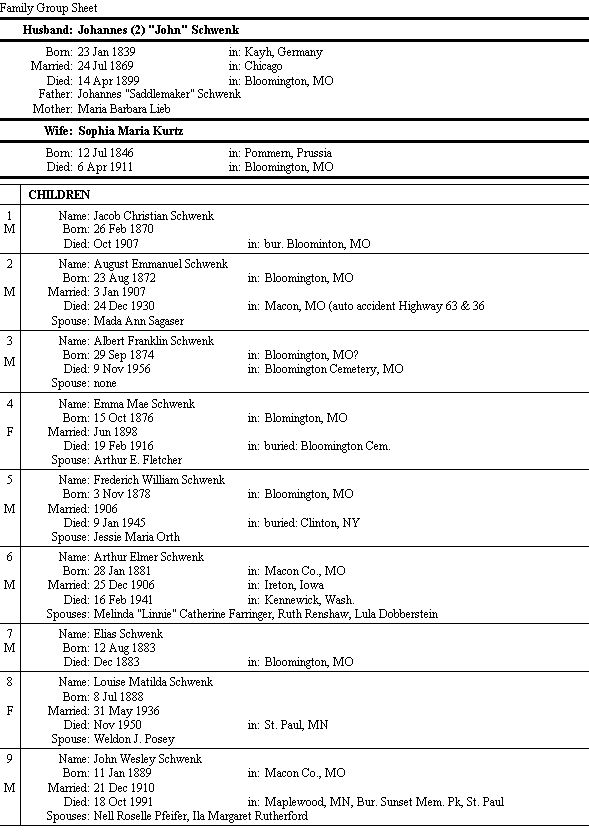
Ten children were born to this union of John and Sophia. To view this family record, click here. Eight survived: six sons and two daughters. Seven of these married; four of these brought children to the world. They were: August "Gus", Emma Mae, Frederich W. "Fred", and A. Elmer. We (of the John Schwenk Clan) are their descendants, and there are approximately 110 of us living today scattered throughout the 50 states who trace their Schwenk ancestry back to John and Sophia Schwenk. And there are others in America who trace their Schwenk ancestry back to the two sisters and one brother of John; this seventh generation chapter is not meant to exclude those descendants in any way. We all trace our Schwenk roots back to Conrad born in 1601 in Laichingen, Alp-Donau-kreis, Württemberg, Germany. Perhaps this history of our Schwenk ancestry in Swabia will lead to "bigger reunions" of the "John Schwenk Clan" and will include as well the descendants of Maria Agnes, Luise and August.
It is outside the scope of this story to begin another chapter which would tell something of the lives of all eight of those surviving children of John and Sophia, but we will in chapter 8 tell something of the life of Arthur Elmer Schwenk, born 1881 (coming later).
And so it is time to close this seventh generation chapter. John Schwenk, born Johannes, died at the age of 60 on April 14, 1899, in Bloomington, Missouri. His widow Sophia died on April 5, 1911. They rest in peace alongside each other on the gentle tree-shaded slopes of the old Bloomington cemetery about one mile from their old homestead and not far west of Macon, Missouri. And right nearby are the headstones of Christian, Albert and Emma, three of their chldren. And buried in another old cemetery just west of there are two other children, E. August (Gus) and baby Elias.
Other links to my ancestry:
The Breymayer Branch reaches
back to ca. 1575
The Lieb Lineage begins
in 1600
The Many Schwenk Clans in Laichingen