Since that time, I have learned of many new facts and discovered some errors in my earlier research. I have found many distant living cousins both in So. Germany and in America. It is for these reasons that I decided to create this new page in my own Web site. What you will read below is current, that is, this is my version of our Schwenk family history in Swabia as of November, 1998.
There are also many wonderful maps and old photos in the SchwenkNet site which I have not duplicated here. And if you want to learn how I dug up my Schwenk ancestry, you can read Roots Diary in my own Web site.
For new surfers, keep in mind you can download the text onto your own harddrives or print it out and read it later at your leisure. Viel Vergnügen. Don Schwenk
This will be an attempt to tell the story of our Schwenk ancestry beginning with Conrad Schwenk, born 1601, and leading down through the four immigrant Schwenk siblings, Maria Agnes, Luise, John and August, who came to America between the years 1854-1872. With each succeeding generation, a new tributary joined our "mainstream" of Schwenk ancestry. We will explore some of those tributaries.
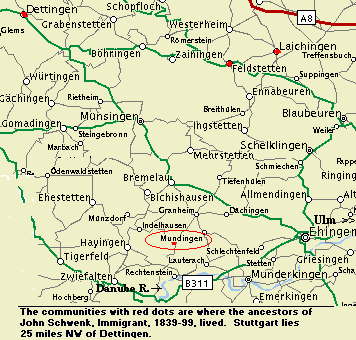
Our ancestry is rooted in southern Germany in what is today the state of Baden-Württemberg and lies in the region between Stuttgart and Ulm. This map should be helpful to the reader/visitor. The rolling, hilly region north of the Danube River is called the Swabia Jura; the Germans call this the Schwäbische Alb.
The word Swabia (also spelled Suabia); in German, Schwaben, comes from the name of a tribe, the Suevi, who amalgamated with the Alemannic peoples in the 5th Century A.D. This grew into a duchy in the 10th Century which continued in the House of Hohenstaufen until 1268. In 1488, the many very small states of this region - the remains of the former large Duchy of Swabia - formed what was called the Swabian League. This was simply a union for self-protection. In 1512, the Holy Roman Emperor made Swabia one of ten "circles" of what would much later become Germany. Swabia encompassed the lands between the Rhine River on the west, and the Lech River to the east (at Augsburg, Bavaria); north to above Stuttgart and south into the northern part of present-day Swizerland. These historical facts are not really important to our story, except that the people living today in roughly the area between Stuttgart and Ulm consider themselves Swabians, and speak a dialect of the German language called Schwäbisch.
The origins of the family name, Schwenk. In Medieval Europe until around the end of the 14th Century, there were no family names. One might be called Hans der Weber (weaver), or App der Mayer (farmer), or Conrad aus Attenweiler, Johann der Schmidt (smith), or Jerg Klein (small). These names, attached to the given or Christian names as you can see, pointed to the occupation, personal characteristic or geographical origins of the individual. And so for the purposes of bringing some order to the record books of the feudal landlords (probably for reasons of taxation), and the need to better identify individuals in a growing population, surnames, heritable family names were required. Friedrich, the son of Johann der Schmidt, would henceforth be named Friedrich Schmidt, regardless of his occupation, personal characteristics, or where he hailed from.
Where did the family name Schwenk come from? According to one book on the history of family names, Schwenk meant "Dweller at the sign of the swan." The Germans considered the swan to be a holy bird. The German verb, schwenken means, "swing; turn, swivel, traverse (a gun); shake about, wave to and fro, flourish, brandish, toss (cooking); rinse (a glass, etc.); sling out (colloquial); Links schwenkt in the military means, left wheel, quick march! (taken from The New Cassell's German Dictionary, pub. 1958). The swan-origins hypothesis seems somewhat plausible, but other scholars believe this familiy name originated in a military milieu.
As you may know, this family name is very uncommon in America. According to one source, there are only about 2000 households with that name. But this name is also fairly uncommon in the German-speaking areas of Europe. For example, the phone book in Bern, Swizerland with a population of perhaps 300,000 in 1994 revealed only one Schwenk. In Dettingen on the Erms River (SE of Stuttgart) pop. ca. 9000, none. In Ehingen just SW. of Ulm and much larger than Dettingen/Erms, also none listed. In the large city of Ulm, however, the phone book in 1994 showed about twenty Schwenk listings. However, in Laichingen, a town about 12 miles WNW of Ulm and with a population of around 9,000 souls, the name Schwenk is today and was 400 hundred years ago more common than Smith or Jones in America. And Laichingen is where our "traceable" Schwenk story begins.
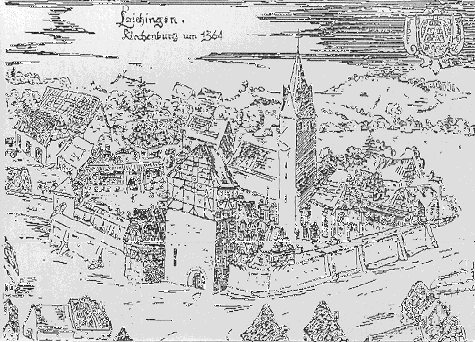
Laichingen and the destructiveness of the Thirty Year's War. Laichingen lies atop the Schwäbische Alb at an elevation of about 2600 feet. In comparison, Ulm lies at 1500 ft. above sea level; Stuttgart at 760'. It is a rolling, agrarian landscape, with the hilltops covered with original forestland and the basins and valleys in croplands and pasture. Hamlets, villages and towns dot the map, and rarely is there more than a two mile distance between them. The economy of Laichingen was and is based on agriculture; and this is true of the many other villages in this region where our ancestors lived. And because it was strictly agricultural, no bombs of World War II fell on these communities. There was, however, a horrible, insanely destructive war some three hundred years earlier, a war between the Protestants and Catholics which was particularly savage in Laichingen and the surrounding area. This was the Thirty Years War, 1618-1648. And because of this war and the wantonness of the Imperial troops in around 1634, the church books (the vital records: births, marriages, and deaths) of the Lutheran (Evangelical) community of Laichingen were destoyed, and with them the birth and marriage records of our "Patriarch" Conrad Schwenk (spelled then, Schwenckh), as well as those - probably - of his parents and their parents. Were it not for the wanton destruction of those records, we may well have discovered two or three earlier Schwenk generations. And this is because in much of Europe, the Protestant churches or parishes began keeping vital statistics during the mid-1500s; the Catholics somewhat later. Prior to this time, religious and temporal authorities did not bother keeping these kind of records. Only the nobility did, for they needed to prove ancestry. We can be grateful to that pastor in Laichingen who in 1657 out of the ashes began recording the vital records of the village in new church books.
In 1949, a Dr. Dieter, then the pastor in the community of Feldstetten (we will talk more of Feldstetten later in this Schwenk story), a smaller "sister community" 2½ miles west of Laichingen, wrote a brief history entitled, Feldstetten During The Centuries. Feldstetten was in the 1600s and 1700s about one half the size of Laichingen. It suffered the same devastation during the Thirty Years War. The author of that brief history states that the population of Feldstetten in the year 1630 numbered "still 800 inhabitants and 150 horses...in spite of the Pest of the previous years (1626/27). But after the bloody outrages, plunderings, famines and epidemics there were in 1635 only 50 inhabitants present." Further in his writing he states, referring to the population figures, "...in 1652 only 120 and only in the year 1829 was the number of 806 reached again. For the rest (of the communities) the following numbers have come to us: in the year 1654, counted Feldstetten 132 inhabitants, Laichingen, 296....." And so with this we have a feeling for the conditions in which our Conrad and Magdalena Schwenckh found themselves in the first part of the 17th Century.
The First Generation
Conrad Schwenckh, Weaver

This story begins in the year 1601 with the birth of Conrad Schwenckh in the weaving village of Laichingen. We know this from the death register. We do not know the names of his father, mother or siblings. There are, however, a few clues found in the church books which indicate who his father and one brother may have been. This subject will be discussed later in this chapter.
What are some of the historical time markers which can put this year of birth of our patriarch into perspective? King James I of England was crowned two years later; The Jamestown Settlement was founded when little Conrad was six; and when he was ten, the King James Version of the Bible first appeared in print. When Conrad was about to leave his teens, the Mayflower and its one hundred passengers were approaching Cape Cod. And so with these time markers we have a feeling of what was contemporary.
Times were peaceful and prosperous in Laichingen as Conrad was growing up. This village was widely renowned for its quality of linen and produced more of it than any community of comparable size in the region. And Conrad played a small part in that history. He almost certainly learned these skills at the feet of his father in the gloomy weaving cellar room , die Dunk, beneath the floor of their home.
Sometime in the years 1630-1635, Conrad asked a certain Magdalena for her hand. Her maiden name remains unknown to us. She was probably a local lass. We do know she was born in 1607. Her name was found mentioned in the church books only two times: at a christening in 1659 (just two years after the vital records of the parish church were resumed), she served as Godmother. The entry said in part, "Magdalena, wife of Conrad Schwenk, weaver." The other mentioning of her name was in her death entry.
The children of Conrad and Magdalena. We know they had four sons who married and had children. The marriage dates of each were found as well as all of their children. This couple surely must have brought other children into the world, but apparently they did not survive. A careful search was made through the marriage registers from 1657 through 1688; no daughters of Conrad and Magdalena appeared in those pages. A family tree or paternal ancestry chart provided to us by our distant cousin, Heinrich Christoff Schwenk, living in Laichingen today, also shows only these four sons. More about him later.
Hans Jacob was born in 1637. He followed the weaving trade, as did all his brothers. He married on Oct. 30, 1660 to Anna Schlenk, a young woman from Merklingen, a village a few miles northeast of Laichingen. They had fifteen children, of which five survived. He died in 1694 in his home village. The translated text of their marriage appears below:
On Hartmann's Day, 30th of October, Tuesday after 19th Trinity,
were here in the
church consecreated, Hans Jacob Schwenckh weaver, lawful son
of Conrad
Schwenckh of the weavers, also called cooker of cabbage, and
Anna, lawful
daughter of the late Hans Schlenk from Merklingen of the Ulm
Sovereignty"
In the decades following the end of the 30 Year's War, nicknames - and often very odd ones - were common. And so, it seems, our Conrad was known - at least for awhile - as the "cooker of cabbage." When son Andreas married four years later, and later, Johann Heinrich and Bernhard, that nickname was not shown in those marriage entries. Perhaps they were eating better then.
Andreas was born ca. May 1, 1641. Our Andreas. He will take center stage in the following chapter.
Johann Heinrich was born in 1645. He became an important figure in this community. He served as judge for many years on the local court. He also was the Heiligenpfleger, the local parish financial adminstrator, in Laichingen. But he suffered a lot of tragedy in his personal family life. His first wife was Anna Schwenk-Edel; they married on Nov. 17, 1668. She bore eight children. She died on Apr. 1, 1682. He remarried on Nov. 12, 1682 to an Anna Drechsler. She died in childbirth the following November at the age of twenty. His third wife was again an Anna and this time an Anna Schwenk-Schreiner. She bore nine children. One of those was a Johannes. We will meet him later in the year 1752 in a very interesting way. J. Heinrich died there in Laichingen on August 27, 1718 at the age of 73.
In 1998, this writer learned of a male descendant of J. Heinrich who still carries this family name. A Gerd Schwenk born about 1970 who lives in Laichingen. His father is Ernst Schwenk born 1937.
Bernhard was born in 1650. On Feb. 6, 1676, he married Anna Mack. They had ten children, seven of whom survived and married. Our cousin Heinrich C. Schwenk, living in Laichingen today, traces his ancestry back to this Bernhard, brother of our Andreas, and is thus a member of the eleventh generation, with Conrad "the Great" (1601-1686) being our common ancestor.
And now back to Conrad and Magdalena. This story of them and their children has been considerably enriched through information obtained from Cousin Heinrich Schwenk. Besides his family tree, he gave a copy of his company's letterhead and family crest, or actually more of a company charter, to Richard L. Schwenk, the writers's first cousin, who with his wife Caring had visited Laichingen in June, 1995. The company is called,"Konrad Schwenk Leinenweberei und Wäschefabrik". This charter-like document lists all the heads of the company - CEOs (Chief Executive Officer) if we may use this 20th Century term - going back to our Conrad Schwenk, b. 1601. There are ten CEOs which precede Cousin Heinrich and his two brothers. The first was Conrad, the "founder" of this linen weaving company. The next four CEOs, Andreas, Georg, Andreas and Johann Heinrich were not direct ancestors of Cousin Heinrich. We'll return to this subject in a moment. CEO # 6, a Conrad born in 1773 and all the subsequent company heads were indeed direct ancestors of Heinrich. So who were these other four Schwenk "weaving executives" who presumably pushed aside their brothers and cousins, the direct ancestors of Heinrich to take over the helm?
This question led the writer once again back to the Hailey Mormon Church Family History Library and those precious microfilms and a search for this Andreas Schwenk, CEO # 2. Who was he? How did he take over the company? He was not our Andreas, b. 1641. A clue was provided on Heinrich's family tree. Someone had handwritten a note on it indicating that CEO # 5, Johann Heinrich Schwenk, born in 1725, was the third child of an Andreas, b. 1680 "from a different line." Here is what the christening and marriage registers revealed: Andreas, 1680, was the son of a BernhardSchwenk born in around 1650. Bernhard had married an Anna Stump in 1675. Including Andreas, they had at least five other children born between 1676 and 1688. The Godfather at all these christenings was Heinrich Schwenk, judge! We met him earlier. He was the third son of our Conrad. It is the writer's strong conviction that this Heinrich and Bernhard were first cousins! The evidence for this lies below.
When Bernhard and Anna married in 1675, the pastor penned the following words into the Ehebuch: Bernhard, lawful son of Andreas Schwenk, behind the church, with Anna, daughter of Wilhelm Stump. And so now we know the father of this Bernhard. A search for his death date yielded very interesting information. He died on Nov. 20, 1695. His age of 79 at death reveals a birthdate of April, 1616. He was a widower when he died. The pastor described him as "Andreas Schwenk, hinter der Kirchen" (behind the church). More than five years earlier, on Feb. 3, 1690, his wife Waldburga, born Dauer, died. Again she was described as the wife of "Andreas Schwenk, behind the church." Her age of 71 at death gives us a birth year of 1619. Where is this all leading? Well, this leads to the high probability that this Andreas was the younger brother of our Conrad. There were fifteen years separating the births of each, but that was not all uncommon in those days. It seems almost certain that it was this Andreas who became the 2nd CEO of the Konrad Schwenk linenweaving company. Is it not logical that this family-owned business would remain within a nuclear or extended family? At sometime toward the end of that century, perhaps with the death of the above Andreas in 1695, George, the son of our Andreas (is anyone confused?) took over the reins of leadership. Then later, his son Andreas took over as CEO # 4. Then in perhaps the middle of the 1700s, Johann Heinrich, the great-grandson of "Andreas behind the church" began calling the shots. Then, as mentioned earlier, the leadership of this company fell back to Cousin Heinrich's direct ancestors and remains so until today.
Cousin Richard Lloyd Schwenk has offered some incisive thoughts regarding the leadership of this weaving company being sometimes passed between cousins rather than traditionally from father to son. Below are his words written in October, 1996.
"Probably the success of The Schwenk Linenweber Co. in overcoming problems of suitable CEO successors was their flexibility in selecting the most able from among the sons and cousins and not confining their choice to just the oldest son of the incumbant CEO."
But wait! We are not finished with "Andreas behind the church." He and Waldburga had at least four children. Three were boys born before 1657. They all married and continued contributing to the "Schwenk overpopulation" of Laichingen. The only child whose birth record was found - and she apparently was the last-born child of this union - was an Anna Ursula. She was born on March 27, 1658. The pastor wrote that the father was "Andreas Schwenk jung (junior), weaver. Mother was Waldburga Dauer from Stubersheim." What is of particular significance here is the word jung! That has to mean that his father was also named Andreas. Some pastors used the latin word, Junior. Most used the word, Jung. Often, in order to identify the individual when there were many persons of the same name - which was certainly the case in Laichingen - the words, "der jünger" or "der älter", the younger or the older, were written after the names. But Jung after Andreas's name means he was a junior. And so it follows, that if this writer's hypothesis holds water, then the father of our Conrad and Conrad's brother Andreas was an Andreas Schwenk, and he would be our earliest documented Schwenk ancestor. His estimated year of birth would be sometime between 1570 and 1580. A persistent search for his death date revealed nothing. He must have died before the church books were reinstituted in 1657. This writer and descendant of our documented patriarch Conrad hopes the reader has not become hopelessly confused with all the Andreas', Conrads and Heinrichs, but the story of the Konrad Schwenk Leinenweberei Company's chief executive officers and the probable relationship between the first five of those had to be told; and as well, the connection of these to the likely father of our Patriarch, Conrad.
Back in 1974, the Konrad Schwenk Linen Weaving Co. hired a firm in Stuttgart to research the early ancestry of this Schwenk line. The name of the firm is "Wappenarchiv Dochtermann." It specializes in designing coat of arms, authenticating ancestry, etc. It was this hired research which led to the creation of the list of CEO successors of this linen weaving company. In their search, they came up with an interesting anecdote about our Conrad, the founder of this company. First of all, their research confirmed that Conrad's nickname was "Köchinen Coles" , cooker of cabbage; but more interestingly, perhaps, that reportedly he and two other members of Laichingen were captured by Austrian troops on Sept. 27, 1646 and marched toward Pfullingen. While on what is called the Honauer Steige, a trail, the three prisoners escaped. The information of this event was recorded in a report by the Vogt, marshal or provost, of Urach, and sent to Duke Eberhard III of Württemberg
The commonness of the family name Schwenk in Laichingen. We have already learned of this in the opening section of this story. But to further illustrate this, here are some of the marriage entries back in 1658 through 1661. The population of Laichingen was then around 300. Marriages were few and far between. There were three weddings in 1658. One of those was between a Maria Schwenk, daughter of the "honorable Andreas Schwenk, judge and weaver." The groom was Johannes Mangold. They, are incidentally, also two of our ancestors. In 1659, only one couple pledged its vows. That was Ursula Schwenk, daughter of "the honorable Christoph Schwenckh, toll official and master candlemaker." She married Cyrianus Schüttenhalm, wagonmaker. The wedding in 1660 was that of Hans Jacob Schwenk, above mentioned. Four events of matrimony occurred in 1661. In one of those, Margarette Schwenk, widow of Georg Wäng, married Jacobus Brüttinger. She, as it turns out later, will be the "great-grandmother" of our cousin Elsbeth Schwenk-Schwahn. The story of her (Elsbeth) appears at the end of this chapter.
The following entry in the church registers was made in 1945!
Of the seven marriages (actually only six appear on this page),
one involved a bride born Schwenk. Here is the entry for her and hubby:
1581. Görg Vürker and Margretta Schwenck had a wedding
on the 3rd of Oct.
The other marriage entries on this page were equally as terse. None showed parents nor occupations of the groom. We can be happy that the Church began making more detailed entries in the following centuries. But here we have additional proof that there were Schwenks living in Laichingen in the 16th Century (actually there are documents showing this family name in Laichingen as early as 1383). Who will ever know...perhaps Margretta was the sister of our Conrad's grandfather?
This chapter ends with the death of Conrad Schwenk, b. 1601. As shown
in the death register, he died at the age of 85 on Feb. 23, 1686.
Here is the translation in English:
And near the Autumn of 1689 on Sept. 13th, our great-grandmother Magdalena joined him in eternal rest. She had lived 82 years. They had both lived long lives when measured even by today's standards. Before we move to the next generation-chapter, here is another anecdotal story which deserves the light of day.
The following is a slight departure from the telling of the story of our Schwenk ancestry, but it is closely related and earns a place here. It begins with a letter written on May 25, 1994, to an Eberhard Schwenk of Schelklingen, a town just north of Ehingen. The writer had jotted down the address from a phone book while visiting the Mundingen/Ehingen area that month. The letter asked whether Eberhard might be a descendant of a Johannes Elias Schwenk (son of Elias, brother of our John) born in Urspring in 1870, a village right near Schelklingen. And if not, was perhaps a Schwenk of Feldstetten one of his ancestors? Sometime later, a reply came from his sister, Elsbeth Schwahn, born Schwenk. Her friendly letter said that her brother had passed away a few years earlier. She enclosed a paternal ancestry chart which her father had prepared back in around 1940. This was a common occurrence in those days, a requirement by the National Socialist Party; through this, one proved one's Aryan ancestry. The chart or tree leads back seven generations to a Peter Schwenk, a farmer, born in Laichingen around 1720-30. Wow! Exciting stuff! A quick glance at the maps showed Laichingen to be only an hour's walk east of Feldstetten. All kinds of questions arose from this letter and chart. Was Peter perhaps the father of our Conrad (b. 1773) or the brother of Conrad's father? The reader must keep in mind that in May of 1994 all we knew was that Conrad (brewer) was born probably in Feldstetten in circa 1765. We knew nothing of his Laichingen ancestry, nor that the family name, Schwenk, was as common as mud in Laichingen.
After the Mormon Church's microfilmed records of the church books were discovered by this writer in Feb. 1995, and after the bulk of the search for our Schwenk ancestry in Feldstetten and Laichingen was completed, a good many days were devoted to find a possible ancestral link between "Cousin Elsbeth" and the writer. Was her "Patriarch" the same as ours, Conrad Schwenk, weaver, born 1601? Or did she descend from a Schwenk metzger or Schwenk schreiner, etc, etc.
This search was not one bit less exciting than the one which had earlier led back to our Conrad "the Great." And it too led to a Conrad Schwenk, born 1610 in Laichingen. But this Conrad was a member of the schreiner (cabinetmaker) clan. His father was a Jörg (Jerg or Georg) Schwenk, schreiner born about 1575-80. And so the question of the consanguineous relationship between Elsbeth Schwahn Schwenk and the writer was not answered fully. They are either tenth cousins or more distantly related. No matter which, a wonderfully warm relationship had developed as a result of her reply in 1994, a lively correspondence, and the subsequent search for the common ancestor!! A chart now follows which shows eleven generations of each. The original - typed in German - was sent to Cousin Elsbeth! For our purposes, it has been "brought back" to English.
Two Different Schwenk Clans
Who and when was the common ancestor?)
| l. Elsbeth Schwahn, born Schwenk, 1928, teacher.
2. Konrad, 1891, teacher. 3. Johannes, 1860, laborer. 4. Johannes, 1828, farmer. 5. Peter, 1786, laborer. 6. Jacob, 1757, farmer. 7. Peter, 1727, farmer. 8. Peter, 1687, storekeeper/farmer. 9. Georg, 1650, weaver. 10. Conrad, 1610, cabinetmaker. 11. Jörg, ca. 1575-80, cabinetmaker. |
1. Donald Earl Schwenk, 1934 Insurance agent/investor.
2. Earl W., 1911, dairy industry/farmer. 3. A. Elmer, 1891, clergyman, farmer. 4. John, 1839, farmer/lay-clergyman. 5. Johannes, 1798, saddler/innkeeper. 6. Conrad, 1773, innkeeper/brewer. 7. Conrad, 1702, weaver. 8. Bernhard, 1672, weaver/judge. 9. Andreas, 1641, weaver. 10. Conrad, 1601, weaver. 11. Andreas (prob.)ca. 1570-80, weaver. |
In May of 1641 when Andreas was born, times were not peaceful nor prosperous in Laichingen. On the contrary. The Thirty Year's War still raged, and a peace agreement would not be made until Andreas reached his seventh birthday. The population of this community in 1634 just before the bloodiest part of the war struck Laichingen and the surrounding areas, stood at around 1200; casualties resulting from combat and later the plague and hunger left Laichingen with only 270 people in the year 1652. That is a loss of about 77 percent of the population. It is not known how many people actually died; many fled to the protection of walled cities such as Ulm and Urach.
When Andreas was a little boy, most of the fields surrounding the village lay in waste. Without the flax grown on those fields, the weaving industry in Laichingen came to a halt and very nearly perished. When the conflict ended in 1648, many families moved to Laichingen from Swizerland, the upper parts of Austria and from villages in the Swabian region to fill up the vacuum caused by this depopulation. Several of those 50 or so families moving in from neighboring villages in Swabia were our direct ancestors.
One of those was Georg Sauter from Nellingen, a village about 7 miles NE of there. He was a baker and brewer. He and wife Waldburga apparently moved in before 1648, for he was honored by the community for his heroism in the spring of 1647. Rather than this writer try to describe what followed, let us have the author of a series of three booklets on the history Laichingen. a Herr Oelhafen, published in about 1964 tell this story directly.
In June of 1995, Richard L. Schwenk and wife Caring stayed overnight
in the very same Rad Inn mentioned above. Little did they know then that
one of Richard's ancestors had been the proprietor some 300 plus years
earlier! About one week later, they returned to Laichingen and
stayed at the Hotel Krehl. A hotel clerk, upon seeing their names, asked,
"Is your name Schwenk? There are lots - no many Schwenks in Laichingen."
This kind lady then phoned a Holger Schwenk, local attorney who speaks
English. Later that day, Holger introduced Richard and Caring to his uncle,
Heinrich C. Schwenk. And that is the serendipity or God's will, or both
- as Richard has described those events - which led us to learn of our
distant cousins in Laichingen! And now back to the Sauter family.
One of the children of Georg and Waldburga Sauter was a daughter named
Barbara. She was born in November of 1641. We do not know where. She and
Andreas Schwenk became more than friends and on May 17, 1664 in the St.
Alban Church in Laichingen said their vows. Here is what the pastor entered
into the marriage register:
Directly beneath that entry, the pastor entered a three-line postscript,
indicating this couple had made a "pilgrimage" to the higher church authorities
in Urach, an administrative city about 14 miles west of there, to seek
permission to marry earlier that year (in March as can be best determined).
Permission to marry then was denied. Reasons not given in the postscript.
Andreas was not quite age 23 in March. Perhaps the denial had to do with
his age. People wishing to marry at that time in the Duchy of Württemberg
had to receive permission from the church authorities (all communities
under the rule of the House of Württemberg were Lutheran since 1534).
In any event, permission was apparently granted later sometime before May
17th. Then on the right margin of the marriage entry, we find the following
words:
"Born on October 15th a son, 1664, in the twenty-second week following the marriage."
And then in different handwriting, directly below the above entry: "Finally, in the month of May, 1667, she paid 12 days penitence in the local Häuslin."
Häuslin translates literally to "little house." It is almost certain this term was the local vernacular for what we sometimes call the "hoosegow", "can", "clink" or jail. This incident illustrates the dim view held by the spiritual community of a newly wedded couple whose first child arrived too soon after the wedding. We must keep in mind that this was not long after the end of the 30 Year's War. The Church was doing its best to bring back prewar standards of morality. Those years of horror and deprivation had caused what German historians call, a Verwilderung, a return to a wild or savage state. And so Barbara's 12 day stay in the Laichingen hoosegow reflected the Church's thinking at that time.
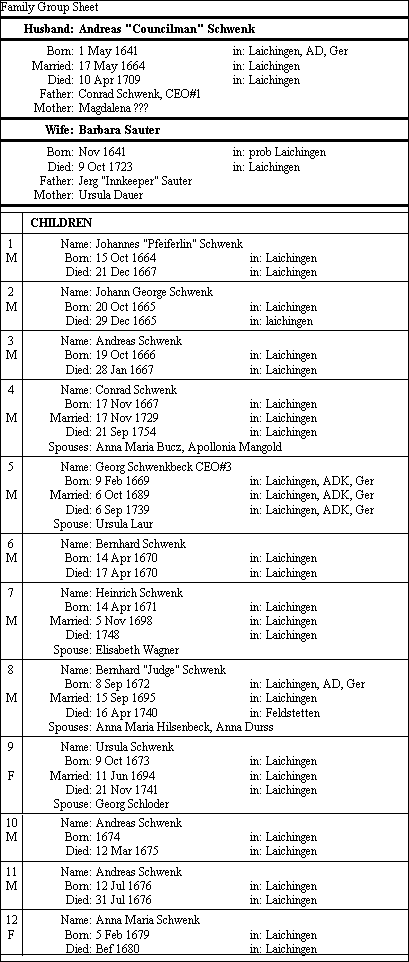
That little first-born was christened Johannes. The father, in the birth register, was noted as, "young Andreas Schwenckh, weaver." So now we know he followed his father's trade. The "young" prefix, but sometimes placed after the name, "the younger", was to identify him from other Andreas Schwenks of Laichingen. A few years later, another Andreas Schwenk married a Barbara and began having babies. One can imagine the grief caused to the researcher trying to sort out the children born to our Andreas and Barbara from the couple with the same names. Only sporadically would the parson add the word "young" by our Andreas' name. Fortunately, he did insert Sauter as Barbara's maiden name! Andreas and Barbara had 12 children, five of which survived and married. You can see a family record of these by clicking here.
As you can see, this was a home in which the cradle never stopped rocking, nor the diapers ever tucked away. Before we learn a little about the lives of those five, let us see what the pastor had to say upon the death of the first-born, Johannes. He made an entry alongside the original birth entry of Johannes. He noted the date and time of death of this little three year old and referred to him as, "Dieses Pfeifferlin", which translates literally to, "this little whistler", and suggests a cheerful little personality.
Conrad. Born Nov. 17, 1667, was a weaver and town council member. His first marriage was with Anna Maria Bucz (sp.?) in February of 1691. She died in 1729. He remarried on Nov. 17, 1729 to Apollonia, daughter of Johann Mangold. No search was made to record the children born in these two marriages, but a son Conrad was born on the 20th of October, 1732.
On April 3, 1752, a certain pastor Bredtt in Laichingen was very busy writing letters to his superiors in Urach. The subject of one of those was the young Conrad Schwenk above. He wanted to marry an Ursula Mangold, age 21. Conrad was then only 19. His age was the problem. It seems that the father Conrad, then age 85, wanted to turn over his property to his young son "before his end" should come. The pastor's penmanship would have won no awards and so the deciphering was difficult. The original which went to Urach may have been more legible than the copy which he scribbled into the church books; in any event, nothing was discerned in the copy which suggested any problem other than the young age of the would-be groom. Close consanguinity of Conrad and Ursula was not mentioned. Apparently Urach gave its approval, for on August 1st of that year, the two were married. Here is their common kinship: Andreas Schwenk 1641 > Georg 1669 > Ursula 1697 > Ursula Mangold 1731. Andreas Schwenk 1641 > Conrad 1667 > Conrad 1732. Thus, the bride and groom were first cousins once removed. Now, keep in mind the wedding date of Aug. 1, 1752. Other interesting events occurred on that date. We will learn of those later. Conrad, son of Andreas, died on Sept. 21, 1754, nearly to the age of 87, but lived to see his young son marry.
Georg. Born on Feb. 9, 1669. On Oct. 6, 1689, he married Ursula, the daughter of the late Johann Laur, former weaver in Laichingen. Through the year 1705, they brought seven children into the world, three of which survived. One of those was Andreas. We learned earlier that Georg took over the Konrad Schwenk weaving company as CEO # 3 from his probable great uncle, Andreas Schwenk. Georg, while a young man, became a baker. The community began calling him Georg Schwenk, Beck (baker in the local dialect). The name stuck. All his descendants carry the name of Schwenkbeck. You can learn more about Georg and the Schwenkbecks in this Web site at: Schwenkbeck.
One of those seven children was Ursula, christened Anna Ursula. She was born on March 9, 1697. At age 22, she married Hans Jerg Mangold, a farmer, weaver and attorney in Laichingen. That wedding took place on Oct. 3, 1719. Now the story get weirder and weirder. We have already learned about one of Hans and Ursula's children in the preceding paragraphs, the Ursula who married the grandson of our Andreas. But another daughter, Anna Maria, born on Sept. 2, 1721, would later become one of our direct ancestors! She would marry an Andreas Ostertag in 1742 and they would have a daughter would later marry one of our Schwenk ancestors. Let us wait until Generation # 4 to see that connection.
Ursula, daughter of Georg, who had married Hans Jerg Mangold, brought eight children into the world. Two were just mentioned. On Dec. 10, 1738, she was widowed with the early death of Hans Jerg, then only age 40. She was left with three children to care for, but she did not remarry until her youngest, Ursula, was old enough to marry. That was in 1752. And now we return to the parsonage library to find Pastor Bredtt writing this second letter to his superiors in Urach. He had just finished writing the letter concerning that 19 year old Conrad Schwenk and the 21 year old Ursula Mangold. Now it seems another Schwenk wanted to marry a Mangold woman. This time, age was not the problem, rather a possibly too close consanguinity. The would-be groom was Johannes Schwenk, widow, age 65. Remember him? He was the son of Heinrich, younger brother of our Andreas. He wanted to marry Ursula Mangold, then age 55, the daughter of Georg Schwenk and widow of Hans Jerg Mangold. Herr Bredtt drew a diagram in his letter showing the kinship of each of the two. Conrad Schwenk 1601 >Joh. Heinrich 1645 >Johannes 1687. Conrad Schwenk 1601 >Andreas 1641 >Georg 1669 >Ursula 1697. Once again, Pastor Bredtt's superiors said, "okay." And so on Aug. 1, 1752, a mother and daughter married their first cousins, once removed; three of the four were born with the Schwenk name.
(This writer learned this year of a Juergen Mangold living in Laichingen. He and his two sons Thilo and Thorsten are distant cousins who likewise descended from Hans Jerg Mangold and Ursula Schwenk. Thus Juergen and sons are distant cousins through Schwenk, Mangold and Hilsenbeck lines!)
But this little tale is not over. On the very same date in the same church, another Schwenk said his vows. This time, Pastor Bredtt had no need to seek special dispensation for the pair. The groom was Peter Schwenk; the bride was Christina Gauss. Peter belonged to the Schwenk Schreiner clan of Laichingen. And as it turned out, Peter and Christina are direct ancestors of our cousin Elsbeth Schwenk-Schwahn! August 1, 1752. What an interesting day that was!
Now back to Georg. When his wife died on Oct. 1, 1736, at the age of 68, she was shown as the wife of Georg Schwenk, weaver and Maierbauer This term was used to describe a large farmer. And so it seems that Georg was a very prosperous man in the community. Georg died on Sept. 6, 1739.
Heinrich. Born 14 Apr 1671. He married Elizabeth Wagner on 5 Nov 1698 in Laichingen. They had six children, one of which was Anna. She married a Philipp Hilsenbeck in 1708. A Johannes Hilsenbeck born in 1922 in Laichingen and still living today (11/1998) is one of their descendants. Heinrich and Elisabeth had only one son who died as an infant. Heinrich died in 1748 in Laichingen.
Bernhard. Born Sept. 8, 1672. Ours. The central character
in the next chapter.
Ursula. Born Oct. 9, 1673. She married on June 11, 1694 to Georg
Schlatter of Laichingen. They brought ten children into the world. She
died on 23 Nov 1751 in Laichingen.
And now back to Andreas and Barbara. They nearly got lost in the shuffle. It is painfully difficult to paint a complete picture of Andreas and his life when all there is to paint with are a few scribbled entries in the birth, marriage and death registers; All we can do is sketch an outline. If one could visit the town hall in Laichingen or the archives in Stuttgart, and get permission to peruse the old tax records, property sales and citizenship records, a more complete picture would emerge. For now it seems we'll have to be content with what the church books reveal. This holds not only for Andreas but for all the generations down to our immigrant ancestors.
In 1665, when baby Johann Georg was christened, Andreas was a "Weber und Haus Metzg." Translated: Weaver and house butcher. In those days a villager butchered right on the street directly in front of his house, or hired someone to do this. Keep in mind that part of the ground floor of the residence contained stalls for livestock and still does today in agrarian communities. A regular "Metzger" or butcher conducted his business (and still does) in the ground floor of his residence; in other words a regular retail store. A "Haus Metzger" would be one who goes to the customer's home to provide the butchering service, a "custom butcher" he is called - at least in the western United States. In 1666 with the birth of his third child, only "weaver" appeared by his name. "Haus Metzger" is not mentioned again. Apparently our Andreas gave up this sideline job of butchering. We know that later he became a member of the town council. His name was seen often in the birth registers as Godfather. In the search for Elsbeth Schwenk-Schwahn's ancestry, he was found to have been Godfather for all eight of the children born to her Georg Schwenk (b 1650). It is interesting to speculate whether Georg and Andreas were first cousins or just good friends. If their paternal grandfathers, Jörg Schwenk, schreiner and Andreas Schwenk, weaver were indeed brothers, then they were more than just good friends.
Andreas' life came to an end on April 10, 1709 in his home village. The simple, brief entry (the pastor at that time entered nothing but brief entries) went as follows:
And so end the lives of our Andreas and Barbara and with those this
chapter. Well sort of. There is another subject which must be woven into
this story somewhere. This looks like a good place. It has to do with the
clergy, the church books and some of the curious entries made in those,
particularly during the 17th Century.
Some curious comments and customs. The parish clergymen of the 17th Century often wrote very personal comments in the various vital records registers - at least in the parishes of our Swabian ancestors. By the 18th Century, the entries are far more objective. Apparently their superiors advised them to keep their opinions to themselves - or at least not put them down in black and white. From thenceforth, the reading becomes somewhat less entertaining! Here are some examples of both caustic and kind, mean-spirited and compassionate, put to paper by those men of the cloth.
In October of 1659 in Laichingen, Georg Wäng died. The parson entered a thorough description of the deceased. "....nicknamed Hägers from Setzingen in the Ulm, age 43, married 12 years, has left 6 unmannerly, unruly children behind; was an angry man who treated his wife badly and beat her; had been bedridden for 14 days with Seittenstechen before he died."
His widow was Margretta, born Schwenk who remarried in 1661. We read about her in the first chapter. She and the "angry deceased" were ancestors of our Cousin Elsbeth. Just beneath that marriage entry, the pastor's postscript tells us something of the conditions in 1661. "...because of the famine and not a loaf of bread available, only the closest friends of the couple were invited for a mid-day meal the day after the wedding." In the same year, a widower Georg Gürr married a widow Barbara Huber. After entering the pertinent facts, the parson added, "A specimen of a wicked wench." It seems apparent Barbara had a bad reputation in the community. In another death entry during the same time period, the spiritual leader of the community could not restrain venting his feelings toward the deceased: "He hardly ever attended church services."
Two months after penning in the very unflattering words about the late Georg Wäng, this same shepherd of the church had this to say about another recently departed: "Anno 1659 on St. John the Evangelist's Day (Dec. 27) before 11, was buried Anna Wegst, a 16 year old unmarried daughter, was a pious, modest, virtuous young woman, who during the past two years remained so frail, finally developed edema; was patient, prayed devoutly, prepared herself joyously for death, kept a clear mind until death, was aware of its approach, received on Thomas Day (Dec. 21) the holy communion." Next door in Feldstetten in 1668 after entering the facts of a christening, the pastor added, "It arrived 36 weeks too soon." But that same man had a very compassionate heart. He would, if the infant died within a year of its birth, draw a small mound beneath the name of the infant, sketch in a cross and two flowers on the grave mound. One flower would have a drooping head, the other, upright in full bloom. This writer's interpretation: The two flowers represent the body and the soul; "the body has perished, but the soul lives on." A copy of a portion of a christening book page in 1668 appears below. Directly above the "Magdalena with cross, mound and flowers" appears the birth entry of Anna Maria Hilsenbeck. She will join our Bernhard as his wife in the next chapter.

The subject of illegitimate births was treated in various ways. A few - not many - kept separate birth registers for these. In the regular birth registers, the word, "illegitimate" was always entered, usually beneath the infant's name. Some pastors used the latin word SPUR, meaning the same. Occasionally - this is always strange to observe - the infant's name was entered upside down! If the "wayward" mother knew the identity of the father and would admit this, his name, occupation and town of residence was recorded in the entry.
This is another curious (only from our enlightened 20th Century point of view) entry made in 1707 in the Feldstetten birth register: "Died on the 18th of May early morning, 8 day old illegitimate child of Hans Jacob Weidenkollers from Winterthum out of Switzerland. The Mother is Anna Margaretha Strigedahin from Münsingen. The infant was buried on the following day in the Churchyard with no pomp or ceremony."
Before we move on to Bernhard's chapter, one more curious subject was found while wandering through those old Kirchenbücher. It is often lamented today by many, that our merchants have tried to "take Christ out of Christmas." Could be. But it was interesting to discover that back in the 1600s some clergymen abbreviated certain words whose prefix was the word, Christ. "Xbris" = latin for Christmonth = December. Or "Xmonat" = Christmonat = December. "Xtoph" = Christoph = Christopher. "Xlich" = Christian, the adjective. Were these clergymen trying to save time and space, or was there another reason?
Another weaver! It was one of the oldest occupations and handed down from father to son. Weaving, however, was extremely common in Laichingen, Feldstetten and in the surrounding region. So, let's talk about this subject before "reconstructing" the life of Bernhard Schwenk.
Angelika Bischoff-Luithlen, an author and historian and former resident of Feldstetten, wrote an amusing and historically informative book in 1978 entitled, "Der Schwabe und die Obrigkeit: nicht nur Gemütvolles aus alten Akten und schwäbischen Dorfarchiven." Translated, "The Swabian and the Authorities: not just what is cheerful and agreeable in old Swabian Village Archives". This book is comprised of many short, short stories of how life was for the common man during the past three or four centuries in this part of Germany. One chapter is devoted to the subject of weaving and is entitled, "Bei ons webt älles, bloss dr Pfarrer et", which translated out of that Swabian dialect means, "Around here everyone weaves except the preacher." She tells us that in the territory of Württemberg, weaving had been for centuries a very traditional trade and provided a necessary additional income for most families. With the weaving of linen cloth, a certain degree of humidity is required, and the air in a house would not provide enough moist air for this task. Because of this the weaver's loom in most homes was located in an in-between floor or level between the ground floor and the basement, a Dunk was its name. She writes, "The weaver sat in the company of beets, potatoes and chickens in the damp underworld." We hold an image of the weaver as a woman seated at her loom. This author states that this work later changed to that of men, and that by the 16th and 17th Centuries was an occupation, a guild, an additional livelihood for every man. It was not a healthy means of livelihood sitting before a loom in a poorly lit, damp environment. She calls this trade a "Hungerberuf", referring apparently to the meager income derived and its resulting skimpy meals. She states that a piece of bread with salt twice a day were the only meal times. A common expression in those days was that, "a weaver was not allowed to take on an apprentice unless this youth had suffered hunger for twelve weeks." Another expression was, "a weaver weighs only a sparrow-dropping more than a tailor." She tells the reader that often during the harvest months many weavers from the Laichingen area went to Ulm to work for farmers there and returned to their linen weaving after harvest work was completed. Whether Conrad, Andreas and Bernhard went hungry, sat in damp, dark rooms beneath the floor of their homes, had pale complexions, were light in weight and coughed a lot we'll never know.
Here is a little anecdote about this wonderful author of folklore and history. We Schwenks have a kinship connection to her. Her son Ulrich Bischoff married the sister of the wife of this writer's sixth cousin, Hans Schwenk of Feldstetten. That is what Midwesterners call a shirttail relative.
In 1649, one year after the end of the 30 Years War, compulsory education was introduced in the Duchy of Württemberg. So it seems quite certain that little Bernhard and his older brothers Conrad, Georg, Heinrich and later sister Ursula, entered the Laichingen School House at age six and completed the required six years of education. We will never know if Bernhard attended school beyond the required six years. Probably not. In any case he must have learned his letters well because he became in later years a local judge in neighboring Feldstetten.His principal livelihood appears to be that of a weaver learned as a child at the loom of his father. His brothers were also weavers. As Frau Angelika Bischoff-Luithlen has told us, "around here everyone weaves except the preacher."
Meanwhile just over the hill in Feldstetten a little girl named Anna Maria was growing up. She was 4½ years older than Bernhard. Her father was Philipp Hülsenbeck (or Hilsenbeck) and brewed beer for a living. Her mother's name was Barbara. Sometime before the fall of 1695 these two young people began courting, and on October 15, 1695 a wedding was held in Bernhard's village.
It was not uncommon in those days for the groom to move to the village of the bride if she were an "outsider", and this is what Bernhard did. So at age twenty-three and just married, Bernhard packed up his loom and made the move to his bride's village. This young couple began raising a family in the following year. And according to the birth registers which reach back to about 1589 in Feldstetten, little Andreas Schwenk, born on Aug. 20, 1696, was the first Schwenk born in this community. An additional search of the marriage registers revealed that a Claus Schwenckh from Laichingen married there in September of 1618, but the birth registers recorded no children born of that marriage. He and his bride apparently set up housekeeping back in his village.
Let us pull off the main road for a moment and spend some time getting acquainted with the Hilsenbeck family. Anna Maria's father Phillip had died in July of 1678 there in Feldstetten. He was born in 1628 in Giengen, a town ENE of Feldstetten. He married a Margaretha Pfister in Münsingen in Dec. 1645. Her father was a clergyman in that city. Their first child was born in April 1667 in Feldstetten, and thus became the first Hilsenbeck born in this community. Nine more children followed. Five of these survived.
Their mother died on Dec. 16, 1663 at the age of 37. Philipp remarried in January 1665 to a Barbara Hanser in Feldstetten. She had been a maid for Philipp. She had come to Feldstetten sometime prior to 1664 from upper Austria. Their first child born on 23 Feb. 1665. The local parson made a note as he entered this birth into the birth register that the child was born only a few weeks after the wedding of its parents. He made a similar comment in the marriage register, that the bride was some 32 weeks pregnant. This couple would have six more children -one of those our Anna Maria b. 3 Mar. 1668 - before our apparently very virile Grandpa Hilsenbeck would die on July 13, 1678 at the age of 50. Barbara then remarried the following year to a Ludwig Frickh, a brewer apparently from Gussenstadt. Our Grandma Barbara died two years later on April 20, 1681.
Philipp had fathered seventeen children in these two marriages. Three of his sons also became brewers. Mattheus, born in 1648, later moved to Laichingen and in 1677 bought the "Krone" Inn. There in 1684, he also bought the "Ochsen" Inn for his brewer brother, Caspar. Mattheus was the village attorney for Laichingen from 1683 until 1703. He died in 1721. The third brother who learned to brew suds was Christian, christened Christianus. He remained in Feldstetten. His one son Caspar followed the same trade. Caspar's son, Caspar, was brewer and baker. And his son, Johan-Jacob Hilsenbeck, born Jan. 8, 1750 would likewise become brewer and owner of the "Löwen" Inn in Feldstetten. We will meet him in the next chapter - and in a most interesting way! Again, you can learn more about the Hilsenbeck Clan by clicking on the Hilsenbeck link above, one of the many pages in this Web site.
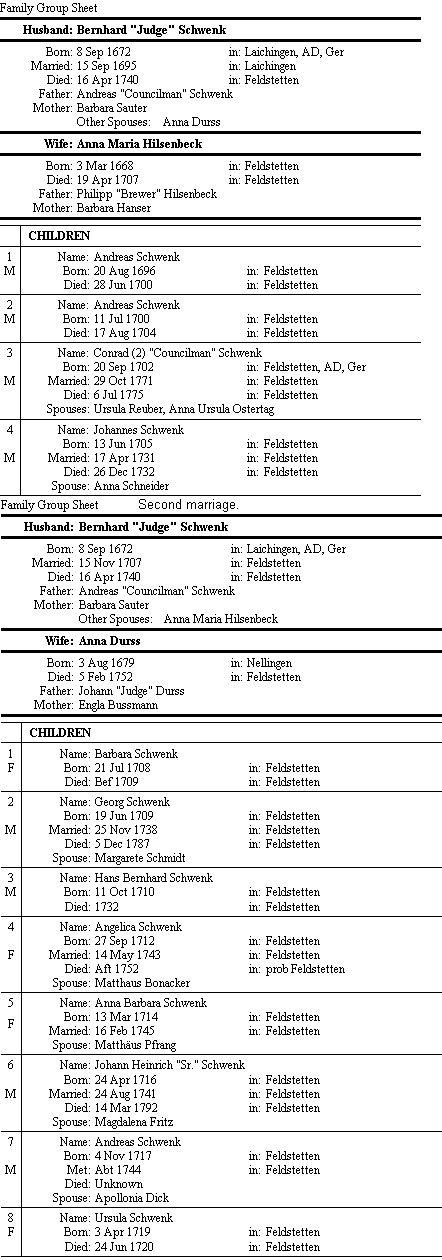
And now back to Bernhard and Maria (she went by her middle name).There must have been great sadness in their home in the early summer of 1700, for their first child, Andreas, died on June 28th. About six weeks later, another baby boy was born. He was given the same name. Oh how our Bernhard so desperately wanted to honor the name of his own father! Two years later on June 20th, 1702, a little Cunrad made his entrance! This was "our" Conrad (spelling modernized), and he would become quite an extraordinary man in this community as we shall later see.
In August of 1704, little Andreas died. The following June, Conrad found a playmate with the birth of his brother, Johannes. Then in 1707 the house was filled with great sadness once again. Maria, while in labor with her fifth child, died. The following words were entered into the death book by the pastor in Feldstetten: "On the 19th of April around 5 in the evening, Anna Maria, wife of Bernhard Schwenck, weaver, died while in childbirth, and the grave was filled with two. She was 39 years of age, and was buried on Tuesday afternoon in the accompaniment of a full church..."
And so here is Bernhard, a young widow with a heart full of grief and two little boys to take care of. The situation did not allow for a long period of mourning before marrying again. And so he married a young woman, Anna Durss, age 28, in October of the same year. Her father, Johann, then deceased, was a member of the court and town council in the village of Nellingen, a community lying about 7 miles northeast of Feldstetten. How he met Anna we may never know. Perhaps Bernhard, then at the age of 35, had become interested in the law, though the title of judge did not appear alongside his name in the birth registers until the year 1714 when Anna Barbara was born. In any case Bernhard and Anna met, and on the 15th of October, 1707 married in Feldstetten, she for the first time. During the years from 1708 through 1719 they had eight children: Four girls and four boys. Click here to view a family record of these two marriages.
All six of Bernhard's sons became weavers, and four of them married there in Feldstetten. A lot of little Schwenks began filling the school house during the following centuries. When this Schwenk visited Feldstetten in May of 1994 and June of 1996, it had a population of around 1000, though strangely only two Schwenk families still reside there. One of those is a Hans Schwenk, b. 1930, a descendant of Bernhard. This the writer documented after the 1996 visit there with Hans, the sixth cousin of this writer. The other Schwenk family is not related to us, at least he is not a descendant of our Conrad 1601.
In April of 1740 the Grim Reaper once again approached the home of Bernhard Schwenk, entered and this time took Bernhard away. The following excerpt from the Feldstetten death books tells us quite a bit about this man, though much from inference: The 16th of April on Holy Easter Eve, Bernhardt Schwenckh, local first judge and weaver passed on. His age was 67 years and 7 months. His final illness lasted 8 days, but with severe pains ex difficulta te emittendi Urinam natis. He was buried Easter Monday with the accompaniment of a large gathering.The funeral text was 1 Peter, verse 1,6"
We don't need to know any Latin to see that the likely cause of death was kidney stones. And we can safely surmise he was a highly respected and probably beloved man in this community, which in 1740 then had a population of around 500. Incidentally, clergymen for many centuries entered quite a lot of Latin words into their Kirchenbücher - we call them church books. It was, of course, a rare common man who could read those words. When a pastor would write a letter to his superior, most of it would be in the German language, with a good many of the words spelled phonetically and not correctly, as was so common in those days. And then, with no apparent reason, an entire paragraph would be quilled in Latin? The motivation behind this custom is unclear to this researcher; in any event, the acquisition of a Latin-English dictionary was necessitated. In 1752, Anna, the widow of Bernhard, passed away there in Feldstetten. The date was Feb. 5, 1752. She was age 72 and 7 months. She died from a fever and some kind of ailment which had troubled her since youth.